
Blog
Travel Trailer Depreciation: How Value Declines Over Time and Why It Matters
Travel trailer depreciation follows a predictable curve, steepest in the first year or two and then leveling off, but the exact number for your unit depends on condition, usage, and market demand. This guide breaks down the typical timeline and explains why a professional appraisal, not a generic depreciation chart, is what insurers, lenders, and courts actually rely on.
Published
Every travel trailer loses value the moment it leaves the dealer's lot, but the pace of that decline is not a straight line. Owners preparing for an insurance claim, a loan application, a sale, or a divorce or estate settlement often want a quick answer: how much has my trailer depreciated? The honest answer is that industry rules of thumb can point you in the right direction, but they cannot replace an inspection of the actual unit sitting in your driveway.
Our travel trailer appraisal team gets this question constantly, and the short version is that depreciation curves are a starting estimate, not a substitute for a documented, defensible value.
How Fast Does a Travel Trailer Lose Value?
Most travel trailers lose the largest share of their value in the first one to two years of ownership, then depreciate more slowly and steadily afterward. Published industry estimates generally place first-year depreciation somewhere between 15% and 25% of the original purchase price, with the rate slowing to a few percentage points per year after that.
Those numbers come from a mix of sources, and they do not always agree. RVshare's depreciation research describes a pattern of roughly 25% loss in the first year, about 10% annually through year five, and closer to 5% annually after that. Other estimates are more conservative. A market analysis from The Camping Nerd puts first-year loss closer to 18% to 21% of the out-the-door price, tapering to 2 to 5 percentage points per year afterward. Neither figure is an official government standard; both are modeled estimates built from auction data, dealer pricing, and market observation.
Unlike cars, there is no single, standardized "blue book" that every lender, insurer, or court accepts for travel trailers. As reporting on RV valuation tools has pointed out, Kelley Blue Book does not maintain a dedicated RV valuation guide the way it does for automobiles, which is part of why trailer owners so often end up needing an appraisal rather than a quick online lookup. If you have ever wondered whether a blue book exists for trailers, the short answer is no, not in the way most people assume.
The Travel Trailer Depreciation Curve: A Rough Timeline
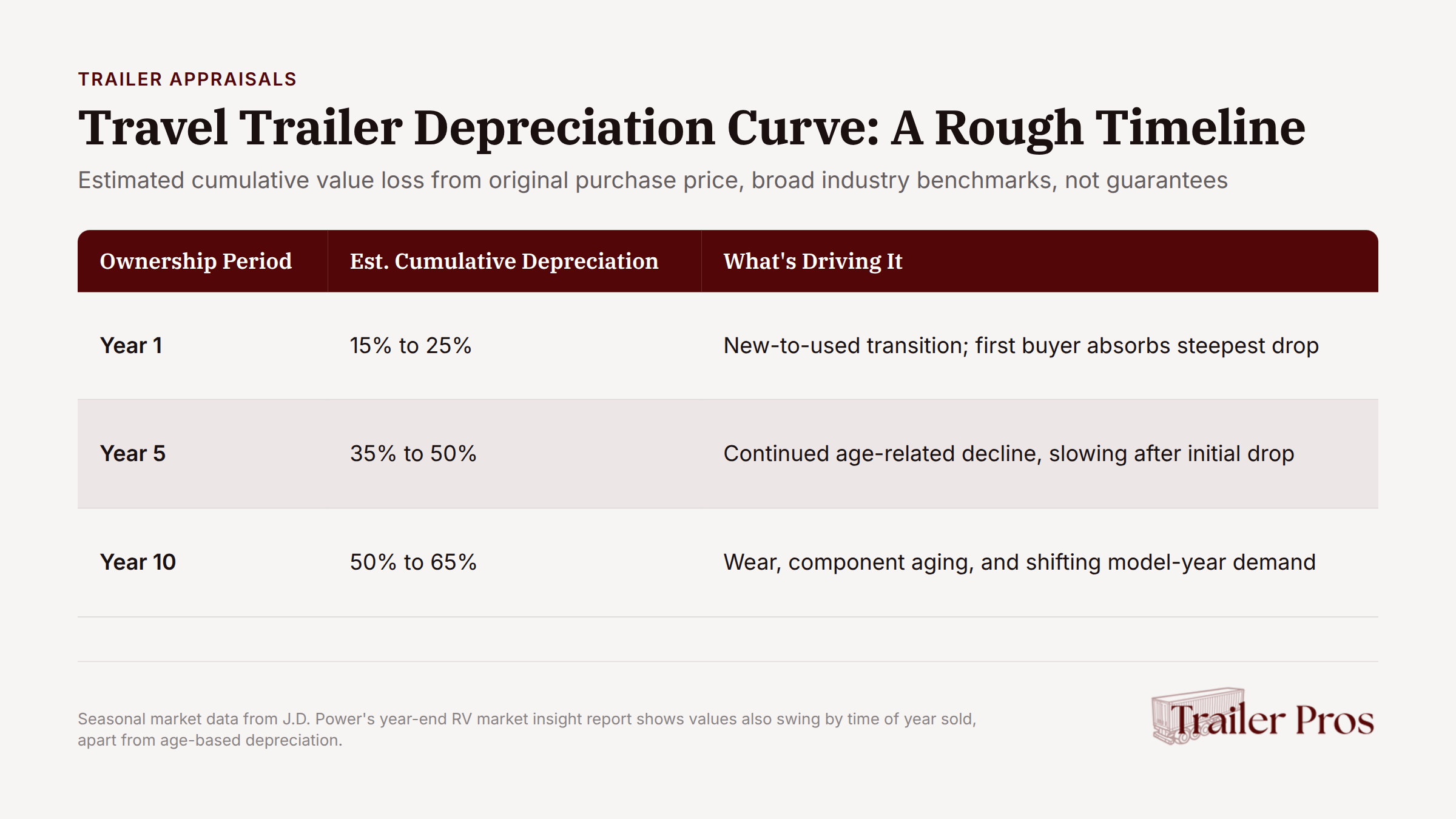
A general depreciation curve helps set expectations, but it should always be read as a broad estimate rather than a precise formula for any single trailer. The following ranges reflect commonly cited industry benchmarks for cumulative value loss from the original purchase price.
| Ownership Period | Estimated Cumulative Depreciation | What's Driving It |
|---|---|---|
| Year 1 | 15% to 25% | New-to-used transition; first buyer absorbs the steepest drop |
| Year 5 | 35% to 50% | Continued age-related decline, slowing after the initial drop |
| Year 10 | 50% to 65% | Wear, component aging, and shifting model-year demand |
These ranges will not fit every trailer. A well-maintained, low-use unit from a brand with strong resale demand can hold value noticeably better than these figures suggest, while a trailer with water damage, a weak brand reputation, or heavy seasonal use can fall well below them. Regional demand matters too. Seasonal market data from J.D. Power's year-end RV market insight report found that standard-hitch trailer values swing by several percentage points depending simply on the time of year they are sold, independent of age-based depreciation at all.
Key takeaway: treat any published depreciation percentage as a planning tool, not a valuation. The only way to know what a specific trailer is worth today is to look at that trailer.
What Determines How Fast a Trailer Depreciates?
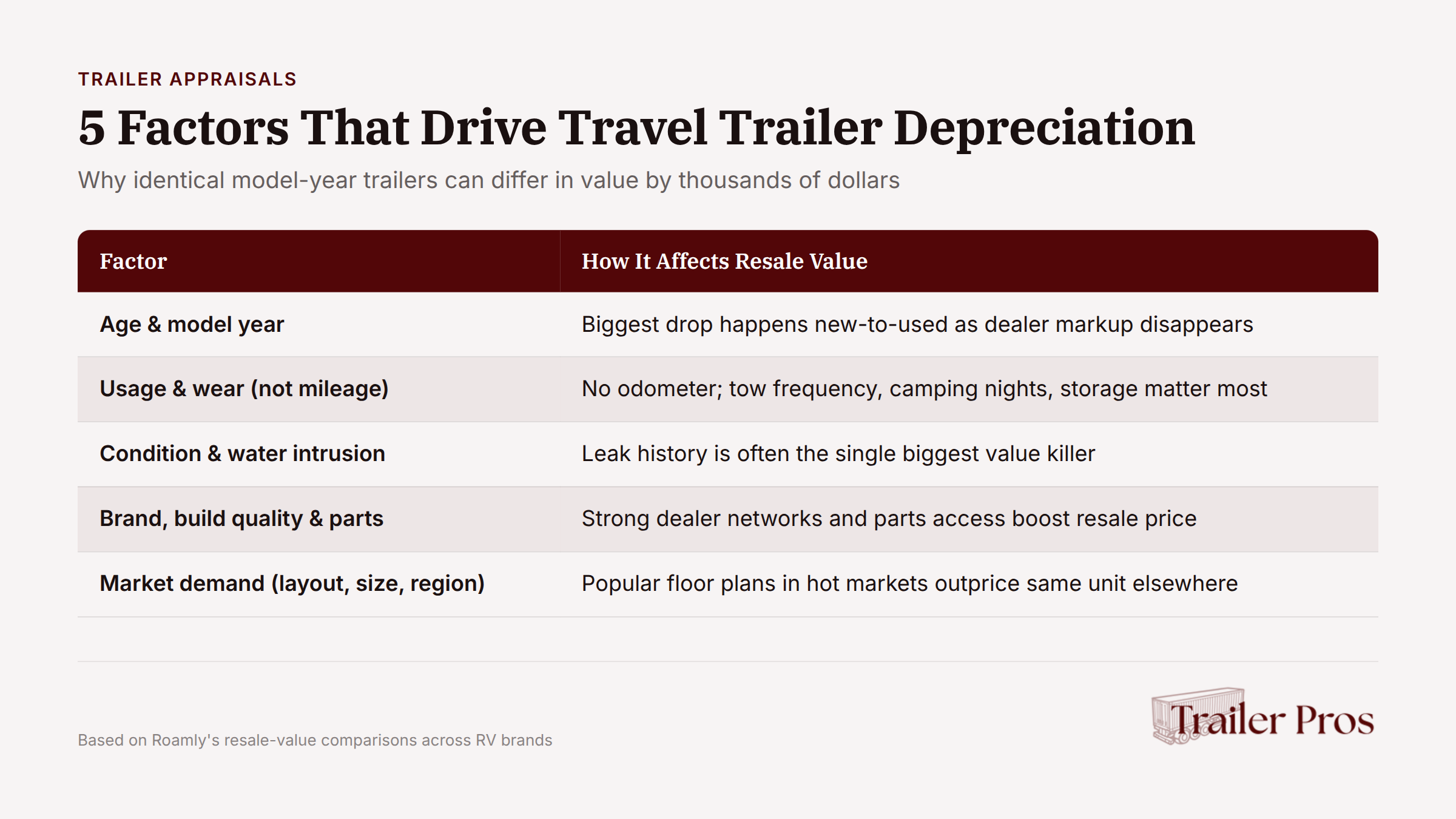
Travel trailers depreciate at different rates because the factors driving value are specific to each unit, not to the category as a whole. A handful of variables explain most of the spread between a trailer that holds value and one that doesn't.
- Age and model year: The transition from new to used causes the single largest value drop, since the next owner is no longer paying dealer and manufacturer markup on a brand-new unit.
- Usage and wear, not mileage: Travel trailers have no engine and no odometer, so tow frequency, camping nights per year, and how the trailer was stored (covered, indoors, or exposed to weather) matter more than any single number. Two trailers of the same age can carry very different depreciation depending on how hard they were used.
- Condition and water intrusion risk: Roof seals, seams, slide-out gaskets, and flooring are the most common failure points, and water damage is often the single biggest value killer in the personal property and RV world. A trailer with a clean moisture inspection history retains value far better than one with a history of leaks, even if both are the same age.
- Brand reputation, build quality, and parts availability: Buyers pay more for brands with a strong dealer network and available replacement parts, since a trailer that is hard to service becomes harder to resell. Resale-value comparisons across RV brands consistently show a meaningful spread between manufacturers with strong reputations and those without.
- Market demand for the floor plan, size, and region: A popular bunkhouse layout in a growth market for outdoor recreation will command a different price than the same trailer in a market with soft demand or oversupply of similar units.
Watch out: two trailers built in the same model year, by the same manufacturer, can have appraised values thousands of dollars apart once condition and usage are factored in. Age alone is a poor predictor of value.
Tax Depreciation vs Market Value: Two Different Numbers
Market depreciation and tax depreciation are not the same calculation, and confusing them is a common and costly mistake. Market depreciation describes what a trailer is actually worth today if sold. Tax depreciation describes how a business or income-producing owner recovers the trailer's cost basis over time under federal tax rules.
For trailers used in a trade, business, or rental activity, IRS Publication 946 governs how the owner recovers that cost through depreciation deductions, generally under the Modified Accelerated Cost Recovery System (MACRS). Depreciation for tax purposes typically begins when the trailer is placed in service, meaning it is ready and available for its business or income-producing use, not simply the date it was purchased, as outlined in the IRS's guidance on sale or trade of business property. If a trailer is used for both personal and business purposes, only the business-use portion is eligible for depreciation deductions.
Some trailers used in rental arrangements may fall under different rules entirely. IRS Publication 527 explains that qualifying residential rental property is generally depreciated under a straight-line method over 27.5 years, though that treatment applies to qualifying residential rental property specifically and is not automatic for every trailer used in a rental business. The IRS depreciation topic page also notes that special rules apply to certain categories of listed property, and that depreciation deductions can trigger recapture when the property is later sold.
None of this changes what a trailer would sell for in the current market. A trailer can simultaneously have a market value determined by comparable sales, a shrinking tax basis on a depreciation schedule, and a loan balance set by a financing contract, and all three numbers can diverge significantly. Confusing a tax depreciation schedule with fair market value is a common error that can distort insurance settlements, loan applications, and estate distributions alike.
Why an Appraisal Beats a Generic Depreciation Schedule
A percentage-based depreciation curve tells you what a typical trailer in a typical condition might be worth. It cannot account for a specific roof repair, a specific set of tow miles, or a specific regional market. That is the gap a professional appraisal is built to close.
An appraisal grounded in comparable sales and a physical condition inspection identifies what similar trailers have actually sold for, then adjusts for the unit's real condition, upgrades, damage history, and local demand. That process is far more reliable than applying a flat industry percentage to the original purchase price, because it accounts for the specific variables a depreciation table cannot see.
Our reports are prepared in accordance with the Uniform Standards of Professional Appraisal Practice (USPAP), and our appraisers hold credentials with organizations such as the ISA, ASA, and AAA. That combination of standards and credentialing matters because these are the specific situations where a defensible, third-party value is required, not assumed:
- Insurance claims and coverage: After a loss, insurers need a documented value tied to comparable sales and condition, not a generic depreciation guess, to settle a claim fairly. Learn more about how our trailer appraisals support insurance claims.
- Financing and loan collateral: Lenders extending credit against a trailer need a current, supportable value to set loan terms and protect their collateral position.
- Resale and pre-sale pricing: Sellers who price using a rough depreciation percentage often leave money on the table or price themselves out of the market; an appraisal grounded in real comparables sets a realistic asking price.
- Estate and divorce settlements: When a trailer is part of a larger asset division, both sides need a value that will hold up to scrutiny, whether that means a probate court, a divorce attorney, or a CPA reviewing an estate.
Pro tip: if you already know roughly what your trailer should be worth based on a trailer value estimate, a formal appraisal is still worth commissioning whenever the number needs to hold up in front of an insurer, lender, or court. Estimates are a starting point; appraisals are documentation.
Getting an Accurate Number for Your Trailer
Depreciation curves are useful for setting expectations, but they were never designed to answer the question that actually matters in an insurance claim, a loan file, or a settlement negotiation: what is this specific trailer worth today? That answer comes from a physical inspection and real comparable sales data, not a percentage applied to a purchase receipt.
If you need a defensible, USPAP-compliant value for financing, a claim, a sale, or a legal matter, you can request a trailer appraisal and our team will scope the assignment based on your trailer's type, condition, and intended use.
This article is provided for general informational purposes only and does not constitute legal, tax, or financial advice. Readers should consult a qualified attorney or CPA regarding their specific circumstances.