
Blog
What Affects Trailer Value Most? Breaking Down Age, Condition, and Upgrades
What affects trailer value comes down to age, structural condition, and documented upgrades, but each factor carries different weight depending on whether you're selling privately, pledging the trailer as loan collateral, or filing an insurance claim. This guide breaks down exactly what appraisers look at and why.
What Determines a Trailer's Value?
What affects trailer value comes down to three forces working together: how old the trailer is, how well it has held up physically, and what has been repaired, replaced, or added along the way. Whether you're selling a trailer privately, pledging it as loan collateral, or filing an insurance claim, the same physical factors drive the number that ends up on an appraisal report. What changes is how heavily each factor gets weighted.
This guide walks through the condition and feature factors that matter most, drawing on the same inspection points our appraisers use when we evaluate a trailer's value for sale, financing, or coverage purposes. There is no single published formula from NADA, J.D. Power, or any other guide that can substitute for a qualified appraiser's holistic review of a specific trailer. Those guides are useful starting points, not finished answers.
The Age and Depreciation Curve
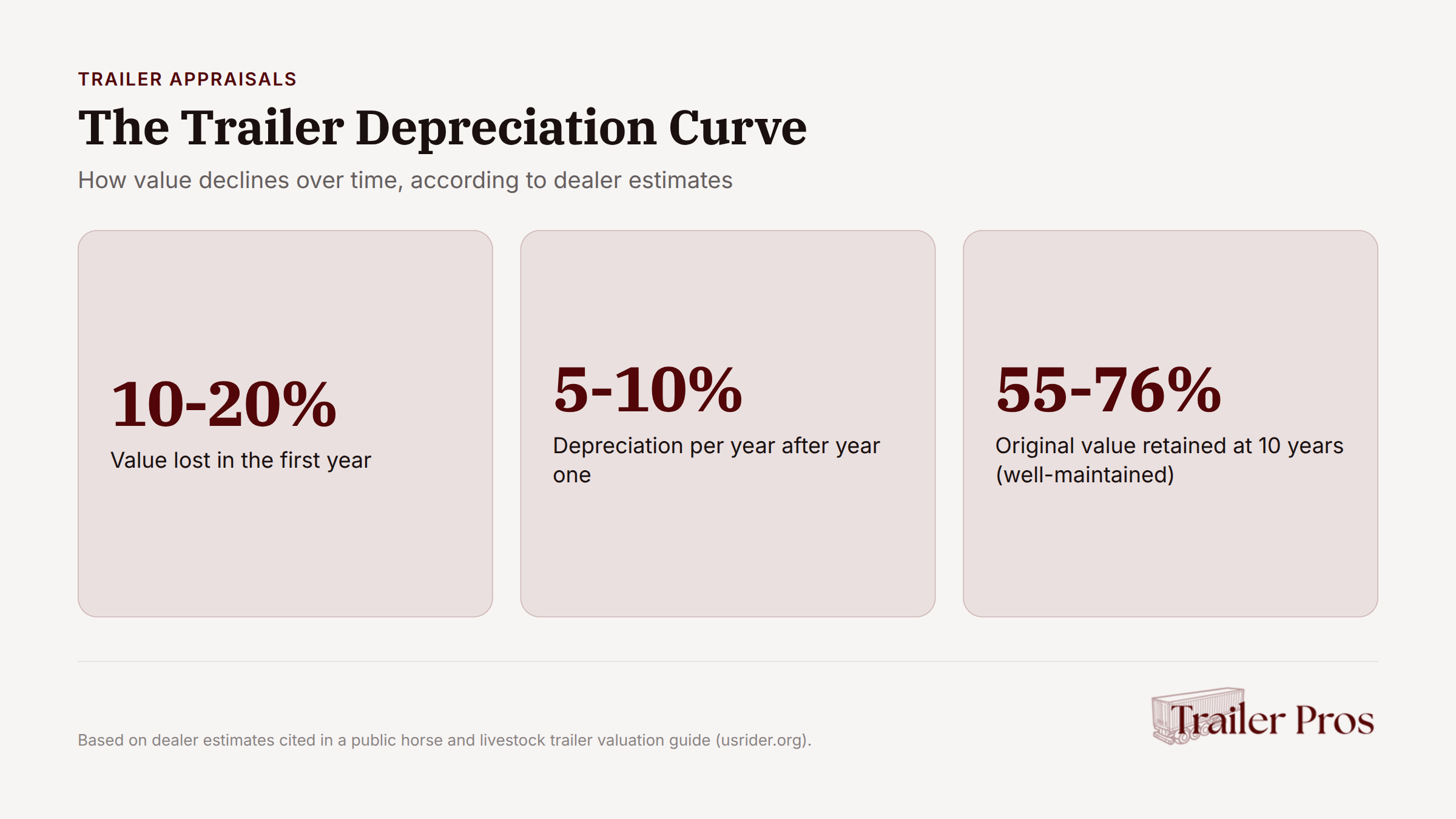
Age sets the baseline, but depreciation is not a straight line and it is not uniform across trailer types. A public valuation guide covering horse and livestock trailers reports dealer estimates of roughly 10 to 20 percent depreciation in the first year, followed by 5 to 10 percent per year after that. The same source notes that a well-maintained trailer can retain somewhere between 55 and 76 percent of its original purchase price at the 10-year mark, depending on type and condition.
That range is wide on purpose. A heavily used commercial flatbed and a lightly used travel trailer of the same age will not depreciate the same way, because usage intensity, structural design, and replacement cost all differ. Age tells you where to start looking. It does not tell you what you'll find.
Key takeaway: Age establishes a depreciation framework, but two trailers built the same year can carry very different values once condition and documentation are factored in.
Frame and Structural Damage: Cosmetic Wear vs. Real Value Loss
Structural problems hit value harder than almost anything cosmetic, because they go to whether the trailer is safe and usable rather than just how it looks. Appraisers and buyers alike treat the frame as the foundation everything else depends on.
The structural issues that most often force a significant downward adjustment include:
- Frame rust, cracks, or poor-quality repairs: Welds that weren't done to spec, or rust that has progressed past the surface, signal a frame that may not hold up under load.
- Floor rot or soft spots: Especially critical in livestock, cargo, and utility trailers where the floor carries the working load.
- Bent or misaligned frame members: Often the result of a prior accident or improper loading, and frequently invisible without a hands-on inspection.
- Compromised axle mounts or suspension hangers: These affect both safety and towing stability.
Example: Two 2016 utility trailers of the same model and mileage come up for comparison. One has a clean, unmodified frame. The other shows amateur weld repairs on a cracked crossmember. Even if both tow fine today, the appraiser will apply a meaningfully larger discount to the second trailer because the repair quality itself is a risk factor, not just the original damage.
Water Leaks and Roof Condition: The Single Biggest Value Killer
Water intrusion causes more value loss than any other single condition issue, particularly in enclosed cargo trailers, travel trailers, and horse trailers with living quarters. A roof leak rarely stays contained to the roof. It travels into wall cavities, subfloors, insulation, and wiring, often long before it becomes visible from the inside.
A public RV valuation guide identifies roof condition and water intrusion as a primary driver of travel trailer value, ranking alongside appliance function and overall interior systems. The reason is simple: by the time staining or soft spots are visible, the underlying structure may already be compromised, and remediation can run into thousands of dollars.
Watch out: A trailer that looks cosmetically clean can still carry hidden water damage. Appraisers check seams, vents, seals around windows and skylights, and the underside of the roof membrane, not just the ceiling interior, because leaks often travel before they show.
Interior and Mechanical Condition: What Appraisers Actually Inspect
Beyond the frame and roof, appraisers work through a consistent checklist of mechanical and interior components that affect both safety and usability:
- Axles, bearings, and suspension: Wear here affects towing safety and is expensive to ignore.
- Tires and brakes: Age-cracked tires or worn brake components are treated as near-term costs a buyer will have to absorb.
- Electrical systems and lighting: Non-functional wiring or lighting is both a safety issue and, for trailers used on public roads, a legal one.
- Couplers, jacks, and ramps: Mechanical failure points that directly affect whether the trailer can be used as intended.
- Interior condition: Flooring, wall panels, cabinetry, and appliances in recreational or living-quarters trailers.
Condition differences here are usually easier to verify than structural issues because they are visible on a straightforward walkthrough. That makes them a reliable adjustment point once the bigger structural and roof questions have been answered.
Do Upgrades Like Solar Panels and Awnings Increase Value?
Upgrades can add value, but rarely dollar-for-dollar against what was spent to install them. A solar panel system, an awning, upgraded axles, or a rewired electrical system may make a trailer more appealing to the right buyer, but the appraised value increase is typically a fraction of the installation cost, not a full recovery of it.
Two conditions determine whether an upgrade moves the needle at all:
- Professional installation. A solar array wired by a licensed installer reads very differently to an appraiser than the same panels mounted and wired by the owner. Workmanship quality affects both safety and resale confidence.
- Documentation. Receipts, component specifications, and installation records let an appraiser verify what was actually done, rather than taking an owner's description at face value.
Example: A travel trailer owner spends $3,200 on a solar panel and battery upgrade, professionally installed with documentation. The appraiser may credit a portion of that cost toward value, commonly well under the full amount, because the upgrade appeals to a specific buyer segment rather than the entire market. An undocumented, owner-installed version of the same upgrade might add little to nothing, and in some cases could even prompt questions about wiring safety.
Personalized modifications that serve a narrow use case (custom interior builds, specialty racking, non-standard electrical setups) can sometimes do the opposite of what an owner expects: they may limit the buyer pool enough to reduce value rather than raise it.
Why Maintenance Records and Documentation Matter
Trailers don't have odometers in the way cars do, which makes documented history one of the few objective signals an appraiser has to work with. A maintenance log, inspection records, and receipts for repairs or upgrades turn an owner's claims into verifiable facts.
Pro tip: Keep a simple folder (physical or digital) with purchase documents, any structural repair invoices, axle and brake service records, and photos of upgrades as they're installed. This single habit does more to preserve resale and appraised value than almost any single upgrade.
Without documentation, an appraiser and a buyer both have to assume the worst about unknowns, because there is no way to verify otherwise. A trailer with thin records gets a more conservative value simply because less is known about it, not because anything is necessarily wrong.
How Trailer Value Weighting Differs by Context: Sale, Loan, and Insurance
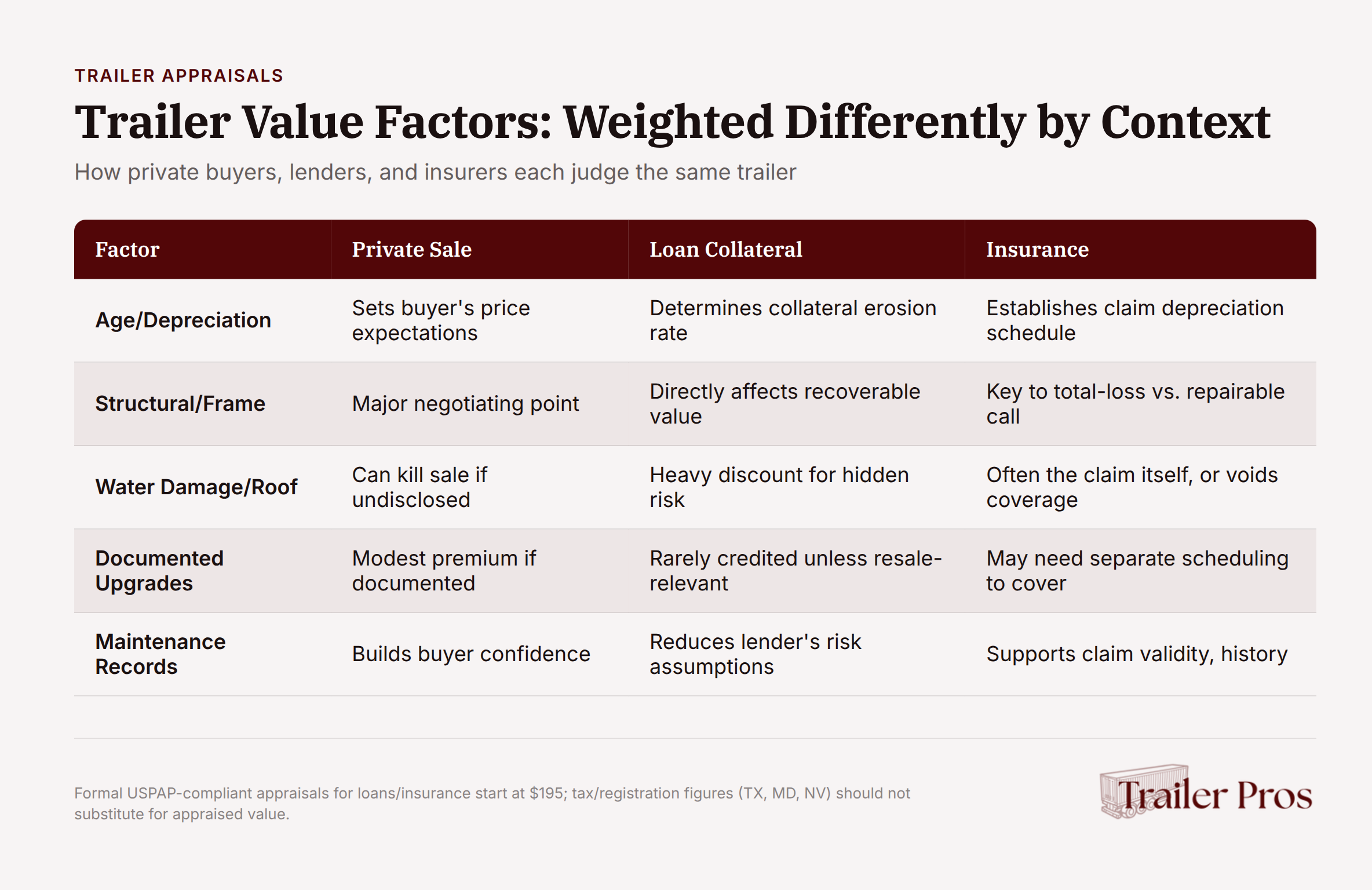
The same trailer can receive different emphasis depending on who is relying on the appraisal and why. A private buyer cares mostly about usability and resale risk. A lender cares about collateral recovery if the loan defaults. An insurer cares about replacement or repair cost and documented pre-loss condition.
| Factor | Private Sale | Loan Collateral | Insurance |
|---|---|---|---|
| Age/depreciation | Sets buyer's price expectations | Determines how fast collateral value erodes | Establishes depreciation schedule for claims |
| Structural/frame condition | Major negotiating point | Directly affects recoverable collateral value | Central to total-loss vs. repairable determination |
| Water damage/roof | Can kill a sale if undisclosed | Lender discounts heavily for hidden risk | Often the claim itself, or voids coverage if pre-existing |
| Documented upgrades | Modest premium if well documented | Rarely credited unless it affects resale | May require separate scheduling to be covered |
| Maintenance records | Builds buyer confidence | Reduces lender's risk assumptions | Supports claim validity and condition history |
This is also where jurisdictions sometimes complicate the picture. Texas treats trailers and semitrailers as motor vehicles subject to motor-vehicle tax in most cases, and Maryland's titling tax calculation is based on fair market value with a stated minimum tax rather than a simple purchase-price lookup. Nevada's governmental services tax, by contrast, starts from a declining percentage of the manufacturer's suggested retail price with a 15 percent floor. None of these administrative figures are meant to double as a resale market value, and using a tax or registration number as a stand-in for an appraised value is a common and avoidable mistake.
For loan and insurance purposes specifically, a formal appraisal is typically required rather than a rough estimate, because lenders and insurers need a defensible, USPAP-compliant opinion of value tied to the trailer's actual condition. A trailer appraisal is quoted as a fixed fee after scoping the assignment, starting at $195 for a standard report, with IRS-qualified and more complex reports priced higher depending on the trailer's type and the depth of analysis required.
Getting a Defensible Number
Age gives you a starting point. Condition, especially frame integrity and water intrusion, does most of the real adjusting. Upgrades matter only when they're professionally installed, genuinely useful to the right buyer, and backed by documentation. None of these factors exist in isolation, and no published guide weighs them the same way an appraiser does for a specific trailer, in a specific condition, for a specific purpose.
If you're preparing to sell, finance, or insure a trailer and need a value that will hold up to scrutiny, our appraisers evaluate each of these factors directly rather than relying on a generic depreciation table.
This article is provided for general informational purposes only and does not constitute legal, tax, or financial advice. Readers should consult a qualified attorney or CPA regarding their specific circumstances.