
Blog
Why Insurance Payouts on Trailers Often Fall Short of Market Value
A trailer insurance payout too low to replace what you had usually comes down to how actual cash value is calculated, not fraud or bad faith. This guide explains the ACV gap and the appraisal clause process that lets you dispute it with real comparable sales data.
If your insurer's settlement check landed well under what it would cost to replace your trailer, you're not imagining things. Most trailer insurance policies pay actual cash value (ACV), a figure built from book guides, depreciation tables, and comparable listings that frequently miss the specifics of your unit. Understanding how that number gets built, and the contractual process for disputing it, is the difference between accepting a low offer and getting paid what the trailer was actually worth. Our insurance claim appraisal service exists specifically for owners stuck in that gap.
What Actual Cash Value Really Means for a Trailer Claim
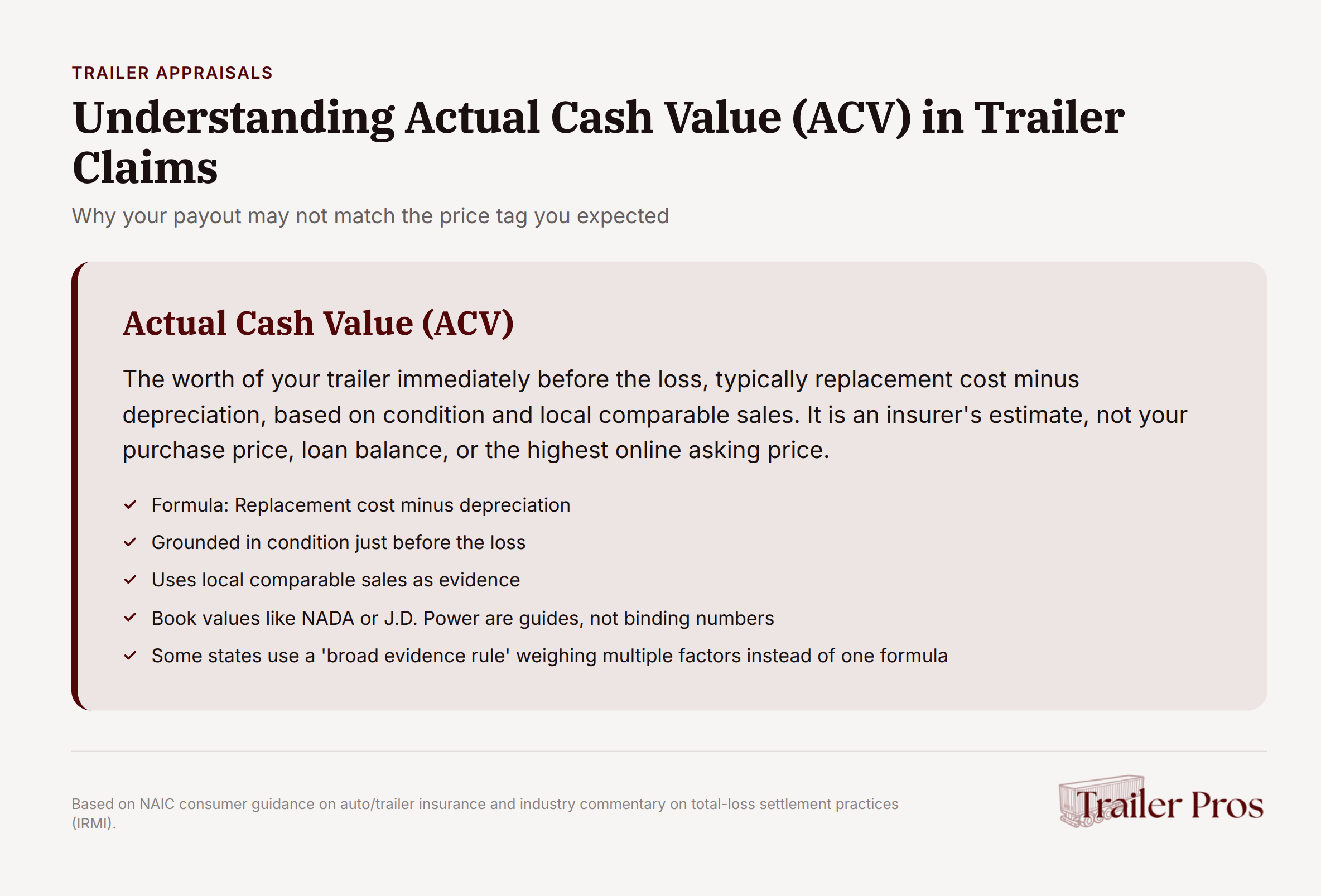
Actual cash value is what your trailer was worth immediately before the loss, not its original purchase price, not your loan balance, and not the highest asking price you found online. The NAIC explains that auto and trailer insurance is meant to pay what the unit was actually worth as a used asset right before the incident, and that a book value like NADA or J.D. Power is only a guide, not a binding number.
Most insurers calculate ACV as replacement cost minus depreciation. Some states instead apply a broader standard, sometimes called the broad evidence rule, that requires the adjuster to weigh multiple kinds of evidence (replacement cost, depreciation, comparable sales, and condition) rather than leaning on a single formula, as industry commentary on total-loss settlement practices describes. Either way, the insurer's number is an estimate built from assumptions, and those assumptions can be wrong for your specific trailer.
Why Book-Guide Depreciation Doesn't Match Your Trailer's Real Condition
Book guides apply a standard depreciation curve to a make, model, and year. They were not in your trailer and have no way of knowing whether you replaced the roof membrane two years ago or still have the original 2009 flooring. A well-maintained travel trailer with a newer water heater and no soft spots in the subfloor can be worth meaningfully more than the guide's generic depreciation schedule suggests, while a trailer with hidden water damage can be worth less.
This matters most for asset categories where condition varies widely within the same model year:
- Travel trailers and fifth-wheels, where roofs, seals, appliances, and interiors age independently of each other.
- Enclosed cargo and utility trailers, where custom racking or shelving may not translate into resale value dollar for dollar.
- Horse and livestock trailers, where flooring, ventilation, and divider condition drive most of the value.
- Specialty and boat trailers, where a thin resale market makes a single generic comparable unreliable.
How Mismatched Comparables Skew the Offer
Insurers are generally required to use comparable units from your local market, not just whichever listings a database surfaces first. Washington's total-loss valuation rule is a useful public benchmark: it permits insurers to value a loss using comparable vehicles, licensed-dealer quotes, local advertisements, or computerized valuation sources, but it also sets real limits on how those comparables can be gathered. Under Washington's WAC 284-30-391, dealer quotes generally must come from within 150 miles, advertised comparables must be current and local, and computerized sources must draw from vehicles available in the marketplace within 90 days of the loss.
That sounds reasonable on paper, but in practice it means an adjuster working from a national database may pull comparables from a different region entirely, with different demand, different towing-package norms, and a different pool of buyers than the market where your trailer actually sold. If you want a second opinion before you sign anything, our trailer value guidance walks through how real comparable sales data is actually built.
Upgrades and Features the Guide Often Misses
Book guides are built around base trim levels. They rarely credit the specific configuration that made your trailer worth more to a buyer than a stripped-down equivalent. An accurate valuation has to account for:
- Axle and suspension upgrades, including torsion versus leaf-spring setups and added axle capacity for heavier loads.
- Flooring and interior condition, especially replaced subfloor, upgraded cabinetry, or newer appliances.
- Winterization and climate packages, such as enclosed underbellies, heated tanks, or arctic insulation that buyers in colder markets pay a premium for.
- Hitch type and towing hardware, since a gooseneck or fifth-wheel conversion changes which buyers and tow vehicles are compatible.
- Slide-outs and awnings, which materially affect livable space and resale appeal on travel trailers and fifth-wheels.
A computerized source is required to account for major options, but "major options" as defined by a national database does not always capture trailer-specific equipment the way it does for passenger vehicles. If the adjuster's worksheet lists your trailer as a base model when it isn't, that gap shows up directly in the settlement check.
Local Market Demand the National Guide Can't Capture
A generic valuation database smooths out regional demand. A horse trailer in a ranching region, a food trailer in a market with heavy event or festival activity, or a travel trailer in an area with strong RV tourism can command a real premium over what a national average suggests. None of that shows up in a depreciation table built for the whole country. It only shows up in actual local sales, which is exactly the kind of evidence an independent appraisal is built to document.
The Appraisal Clause: Your Contractual Path to Dispute a Low Offer
Most property and auto policies that cover trailers include an appraisal clause, a contractual dispute mechanism separate from litigation. It generally works in four steps:
- Submit a written demand for appraisal. You notify the insurer in writing that you are invoking the appraisal clause and disagree with the amount of loss.
- Each side selects its own appraiser. You hire an independent appraiser; the insurer names its own.
- The two appraisers try to agree on the loss amount. They exchange valuations and supporting data and attempt to reach a shared figure.
- An umpire breaks a deadlock. If the two appraisers cannot agree, they select a neutral umpire, and any two of the three (your appraiser, the insurer's appraiser, or the umpire) can set the binding amount of loss.
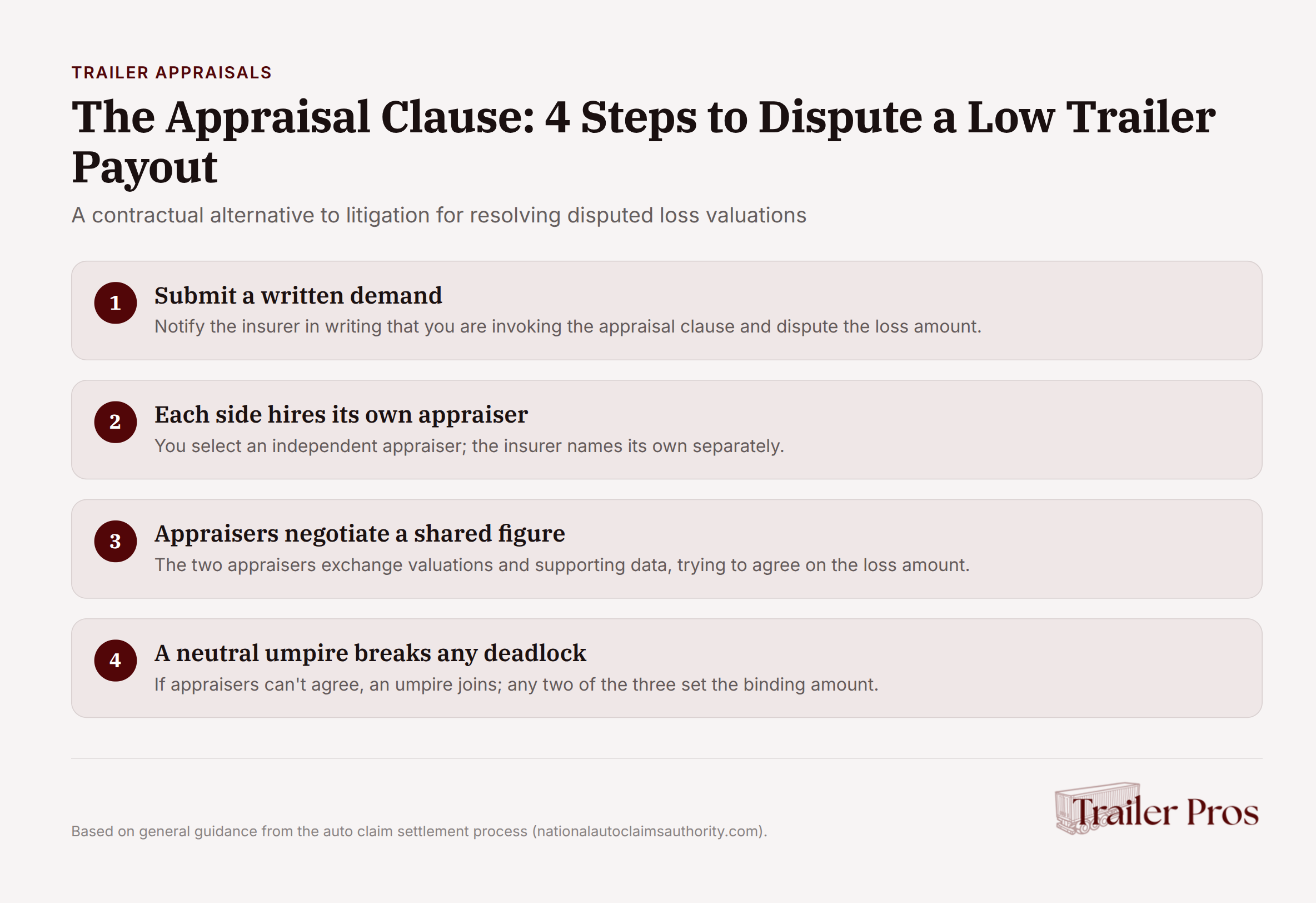
This process is widely recognized across claims-settlement practice as the formal route for resolving a disputed valuation without going to court, as described in general guidance on the auto claim settlement process. It works the same way for most trailer claims once the trailer is covered under a policy with an appraisal provision.
What an Independent Trailer Appraisal Adds to the Process
Your appraiser's job in this process is to produce a defensible, documented opinion of value, not a number picked to maximize your payout. That means real comparable sales (not just listings), accurate documentation of your trailer's specific configuration and condition, and a methodology that can stand up to the insurer's own appraiser and, if needed, an umpire. Our appraisers hold credentials with organizations such as the American Society of Appraisers and the Certified Appraisers Guild of America, and every trailer appraisal is prepared in accordance with USPAP so it carries weight on both sides of the appraisal clause table.
Watch out: An appraisal clause invocation does not pause your policy's other deadlines. Proof-of-loss windows, deductible obligations, and any cost-sharing terms for the appraisal process itself (many policies split the umpire's fee) still apply exactly as written. Read your policy's appraisal language before you send a demand letter.
Our insurance claim appraisal service is quoted as a fixed fee before work begins, typically $395 to $595 depending on the type of claim. When a claim moves into the formal appraisal clause process, that work is quoted at $595, which includes up to $200 of negotiation support as your appraiser works to reach agreement with the insurer's appraiser. These fees cover the appraisal and negotiation process itself; they are not a guarantee of any specific settlement amount, since the final figure depends on the evidence, the policy language, and, if needed, the umpire's decision.
What the Appraisal Clause Does (and Doesn't) Decide
It's worth being precise here because this trips up a lot of policyholders mid-dispute. The appraisal clause resolves the amount of loss, meaning what the trailer was worth and what it costs to fix or replace. It does not decide coverage questions, such as whether the policy covers the cause of loss at all, whether a claim was filed in time, or whether an exclusion applies. If your insurer is denying coverage outright rather than disputing the dollar figure, the appraisal clause is the wrong tool; that's a coverage dispute, and it typically needs a different kind of challenge, sometimes through a formal appeal of the claim decision, as outlined in general guidance on appealing an auto insurance claim decision.
Pro tip: Before invoking the appraisal clause, get your trailer's actual configuration documented with photos, maintenance records, and any upgrade receipts. An appraiser can build a stronger comparable-sales case when the trailer's specific condition and equipment are already on record, and that documentation also helps during the negotiation phase described in general guidance on negotiating a total-loss settlement.
Getting a Fair Number Takes the Right Evidence
A low ACV offer is rarely the insurer acting in bad faith; it's usually the predictable result of a generic depreciation curve applied to a trailer with specifics the guide never saw. The appraisal clause gives you a structured, contractual way to put real evidence (your appraiser's documented comparables and condition analysis) against the insurer's generic worksheet. If your trailer's settlement offer looks disconnected from what you know it's actually worth, request a trailer appraisal to get that evidence on the record before deadlines close.
This article is provided for general informational purposes only and does not constitute legal, tax, or financial advice. Readers should consult a qualified attorney or their insurance policy documents regarding their specific circumstances.