
Blog
Donating a Trailer to Charity: How Appraised Value Affects Your Tax Deduction
Donating a trailer does not trigger the IRS's special vehicle-donation rules, so your trailer donation tax deduction appraisal follows the general noncash charitable contribution rules instead. This guide explains the dollar thresholds that require a qualified appraisal, what the report must contain, and how the numbers flow onto Form 8283.
Donating a utility trailer, horse trailer, or cargo trailer to a qualifying charity can produce a real tax benefit, but the deduction only holds up if the paperwork matches what the IRS actually requires. Many donors assume a trailer works like a car donation: drop it off, get a form, deduct the sale price. It doesn't. This guide walks through why trailers are treated differently, when a qualified appraisal is required, and what a compliant Form 8283 filing looks like, using a trailer appraisal for charitable donation as the anchor document for the whole process.
Why a Donated Trailer Doesn't Work Like a Car Donation
A donated trailer is generally not a "qualified vehicle" for tax purposes, which means the special vehicle-donation rules that dominate car-donation advertising usually don't apply to it. The statute and the related IRS guidance on vehicle donation rules cover motor vehicles manufactured for use on public roads, boats, and airplanes. A utility trailer, enclosed cargo trailer, or horse trailer typically doesn't fit any of those three categories, even though it has a VIN and a title.
This distinction matters because vehicle-specific rules include Form 1098-C, issued by the charity, and a deduction limit tied to the charity's actual sale proceeds unless an exception applies. If your trailer isn't a qualified vehicle under that framework, you won't get a 1098-C, and you're not automatically capped at the charity's resale price. Instead, your deduction is governed by the general noncash charitable contribution rules.
Watch out: Don't assume a trailer donation is capped at "whatever the charity sells it for." That gross-proceeds limit is a vehicle-donation rule. A trailer falls under the general noncash property rules, which means fair market value, properly supported, is the standard that governs your deduction.
The Three IRS Reporting Tiers for a Donated Trailer
The amount you claim for a donated trailer determines exactly what documentation the IRS expects. There is no single rule; there are three tiers, each with its own paperwork.
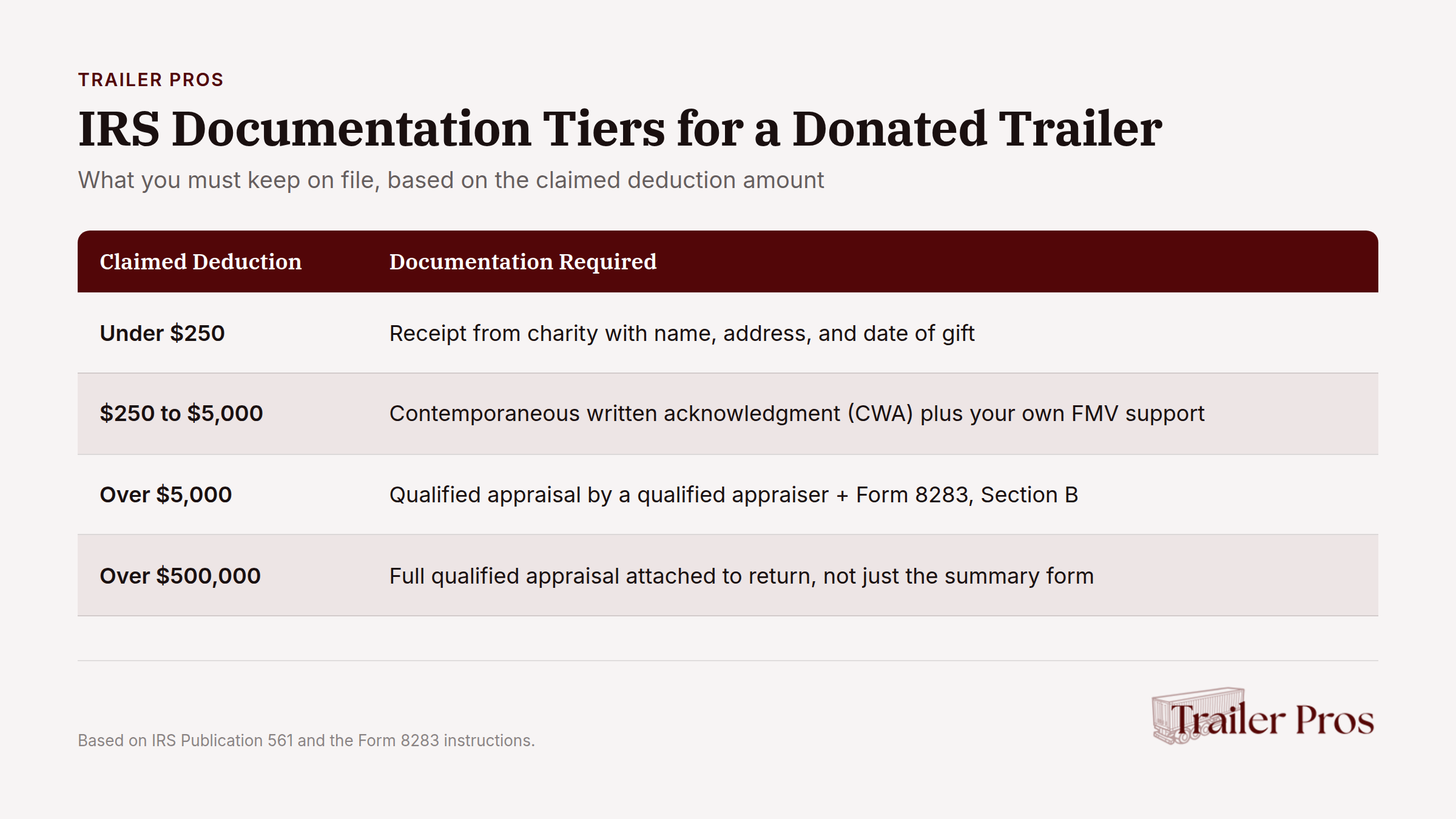
The general noncash contribution framework set out in IRS Publication 561 and the Form 8283 instructions breaks down as follows:
| Claimed Deduction | What the IRS Requires |
|---|---|
| Under $250 | A receipt from the charity showing its name, address, and the date of the gift |
| $250 to $5,000 | A contemporaneous written acknowledgment (CWA) from the charity, plus your own support for the fair market value claimed |
| Over $5,000 | A qualified appraisal by a qualified appraiser, and Form 8283, Section B, attached to your return |
| Over $500,000 | The qualified appraisal itself attached to the return, not just the summary form |
Most donated trailers that are worth appraising at all fall into the third tier. A working cargo trailer, horse trailer, or flatbed trailer in decent condition routinely clears $5,000 in fair market value, which puts the donor squarely into qualified-appraisal territory.
What a Qualified Appraisal Must Include and When It's Due
A qualified appraisal for a donated trailer must be performed by a qualified appraiser, describe the trailer in enough detail to identify it, state the valuation method used, and be dated and signed within the IRS's timing window. The American Society of Appraisers summarizes these federal requirements for donation appraisals in a public guide to IRS gift and donation appraisal rules, which tracks the same substantiation standard the IRS applies to any noncash property over $5,000.
Timing is not flexible. The appraisal must be completed no earlier than 60 days before the date of the donation and no later than the due date (including extensions) of the return on which the deduction is first claimed, per IRS guidance on qualified appraisals. File without it, or get it too early, and the deduction can be disallowed even if the trailer's value was never in dispute.
Publication 561 identifies three acceptable methods for determining fair market value: cost or original selling price, comparable sales of similar trailers, and replacement cost adjusted for depreciation. A qualified trailer appraiser typically leans on comparable sales data (recent private-party sales of trailers with similar age, size, axle configuration, and condition) because that data is usually available and defensible.
Pro tip: Photograph the trailer's VIN plate, tires, floor, hitch, and any modifications before you hand it over. An appraiser working from good photos and maintenance records can support a stronger fair market value conclusion than one working from a vague description.
How Much Does a Qualified Trailer Appraisal Cost?
A qualified, IRS-ready trailer appraisal is quoted as a fixed fee before work begins, never billed by the hour. For trailers, that fee typically starts at $295 for an IRS-qualified report, with most engagements landing between $195 and $495 depending on the trailer's type, documentation, and complexity of the intended use. A trailer with an unusual configuration, extensive customization, or a disputed title history can run higher.
The fee is driven by the scope of the assignment: how much research and documentation the report requires, not by how much the trailer happens to be worth. A $6,000 utility trailer and a $30,000 custom horse trailer can call for a similar level of appraisal work if both have straightforward records, which is why the price is set by complexity, not by value.
Worked Example: Donating a Horse Trailer to a Rescue Organization
Example: A donor gives a 2016 steel-frame, two-horse slant trailer to a nonprofit equine rescue. The donor bought it used for $9,500 three years earlier and has kept maintenance records. A horse trailer appraisal using comparable sales of similar-year, similar-condition slant trailers concludes a fair market value of $7,800.
Because $7,800 exceeds the $5,000 threshold, the donor needs a qualified appraisal and must complete Form 8283, Section B. The rescue organization provides a contemporaneous written acknowledgment describing the trailer and confirming no goods or services were exchanged. The donor's return, filed the following spring, includes:
- Form 8283, Section B, Part I: identifies the trailer by VIN, year, and make, and states the acquisition date and cost basis of $9,500
- Form 8283, Section B, Part III: the appraiser's declaration, signed and dated within the required window
- The rescue's acknowledgment letter: matched to the appraisal's effective date
The donor claims a $7,800 noncash charitable deduction, well under the $500,000 threshold that would require attaching the full appraisal itself, though keeping a copy on file is still good practice. Had the donor skipped the appraisal and simply claimed the $9,500 purchase price, that deduction would have no substantiation and would likely be disallowed on audit.
Completing Form 8283 Section B
Section B of Form 8283 is the section that applies once a single item, or a group of similar items, exceeds $5,000 in claimed value. It has three parts, and each one needs a different signer.
- Part I (Donor Information): You complete this section, describing the trailer, how and when you acquired it, and your cost basis.
- Part II (Donee Acknowledgment): The charity confirms receipt of the trailer, unless it is a "partial interest" gift.
- Part III (Appraiser Declaration): Your qualified appraiser signs, certifying that the report meets the Form 8283 instructions' requirements for a qualified appraisal by a qualified appraiser.
A qualified appraiser cannot be the donor, the donee organization, a party to the transaction that generated the trailer, or anyone who regularly performs a majority of their appraisals for the parties involved in the specific donation. Our appraisers hold credentials with organizations such as the ASA and CAGA, and every trailer donation report we prepare follows USPAP so the file holds up to IRS scrutiny.
Key takeaway: The appraiser's signature on Section B, Part III is what converts your fair market value estimate into a substantiated deduction. Without it, a claim over $5,000 has no legal footing, regardless of how accurate the number is.
Get the Appraisal Before You File, Not After
A donated trailer runs on the same general noncash contribution rules that govern furniture, equipment, and collectibles, not the vehicle-donation rules built for cars. That means the fair market value threshold, the qualified appraisal requirement, and the Form 8283 mechanics described here apply the moment your claimed deduction crosses $5,000. Get the appraisal completed within the IRS's timing window, keep the charity's written acknowledgment, and file Section B correctly, and the deduction is built to withstand review.
If you're planning a trailer donation this tax year, request a trailer appraisal before you hand over the keys so the valuation date, the donation date, and your filing deadline all line up.
This article is provided for general informational purposes only and does not constitute legal, tax, or financial advice. Readers should consult a qualified attorney or CPA regarding their specific circumstances.