
Blog
How Lenders Value a Trailer as Loan Collateral (and What They Require)
A bank or credit union will not accept a trailer as loan collateral on the owner's word alone: it needs clean documentation, a condition review, and a defensible appraisal report tied to underwriting. This guide walks through exactly what a trailer appraisal for loan collateral must show before a lender signs off.
When a trailer secures a loan, whether it is a business owner financing a fleet purchase or an individual borrowing against a horse trailer or travel trailer, the lender is not just curious about what the trailer is worth. It is deciding how much cash it could recover if the borrower defaulted and the trailer had to be sold. That single question drives every document request, every condition note, and every number that ends up in the appraisal report. Our trailer appraisal for loan collateral service exists specifically to give lenders and borrowers a report built for that purpose, not a generic value guess.
Why Lenders Require a Formal Trailer Appraisal for Loan Collateral
Lenders require a formal appraisal because a loan secured by a trailer is only as strong as the collateral behind it. If a borrower stops paying, the lender's recovery depends entirely on what the trailer can actually be sold for, not what the borrower believes it is worth or what a dealer quoted at purchase.
Asset-based lending has always worked this way. When a lending institution extends credit against personal property, strict internal rules typically govern how much can be borrowed relative to the appraised value, and that appraised value is often built around a liquidation-style definition: what the collateral could realistically bring in a distress or forced sale, not its full retail replacement cost. Lenders are not trying to acquire trailers. They want to know how quickly and reliably the asset converts to cash if it has to.
That is why a signed, defensible appraisal report carries more underwriting weight than a verbal estimate or a listing screenshot. It gives the lender a documented basis for the loan amount it is willing to extend, and it protects the borrower from being under-leveraged based on a lowball guess.
What Documentation Do Lenders Require Before Accepting a Trailer as Collateral?
Lenders require four categories of documentation before they will accept a trailer as loan collateral: proof of ownership, proof of registration, proof of insurance, and independent proof of value. Missing any one of these typically stalls or kills the underwriting decision.
Before an appraiser or loan officer will move forward, borrowers should expect to provide:
- Title documentation: the current title showing legal ownership, with the title status (clean, salvage, rebuilt, or bonded) clearly stated.
- Registration paperwork: current state registration confirming the trailer is properly titled in the borrower's name or business entity.
- Proof of insurance: an active policy naming the trailer, since an uninsured asset is a bare risk to the lender from day one.
- VIN and specification records: the vehicle identification number, year, make, model, axle configuration, and GVWR, all of which determine the correct market segment for valuation.
- Maintenance and modification records: receipts, invoices, or shop documentation for any upgrades, repairs, or structural work performed on the trailer.
- Independent proof of value: a signed appraisal report, not a screenshot of an online listing or a dealer's asking price.
Each of these feeds directly into the appraisal. A trailer with a clean title, current registration, and documented maintenance history is straightforward to value with confidence. Gaps in any category usually mean the appraiser has to note limiting conditions in the report, which lenders read as added risk.
How Condition Affects a Trailer's Loanable Value
Condition affects loanable value because a lender is underwriting resale risk, not sentimental worth. An appraiser inspects the structural and mechanical systems that determine whether the trailer can be safely used and quickly resold, and any weakness in those systems reduces the value a lender can rely on.
The inspection typically focuses on:
- Frame integrity: rust-through, cracked welds, or prior collision damage on the frame rails can significantly limit both safety and resale value, regardless of how the trailer looks cosmetically.
- Floor condition: soft spots, rot, or water damage in the deck or floor, especially in livestock, cargo, and flatbed trailers, are a common source of value deductions.
- Axles and suspension: bent axles, worn leaf springs, or mismatched axle capacity relative to the trailer's rated load reduce both function and marketability.
- Brakes: whether the trailer has functioning electric or hydraulic brakes as required by its GVWR class, and whether the brake system shows recent service.
- Tires: tread depth, age, and load rating, since trailer tires degrade with time even when mileage is low.
A trailer that scores well across all five categories supports a value close to the top of its market range. A trailer with frame or floor issues can lose a substantial share of its value even if the tires and brakes are new, because those defects affect whether the asset is safely usable at all.
How Title Status Changes Lender Acceptance and Loanable Value
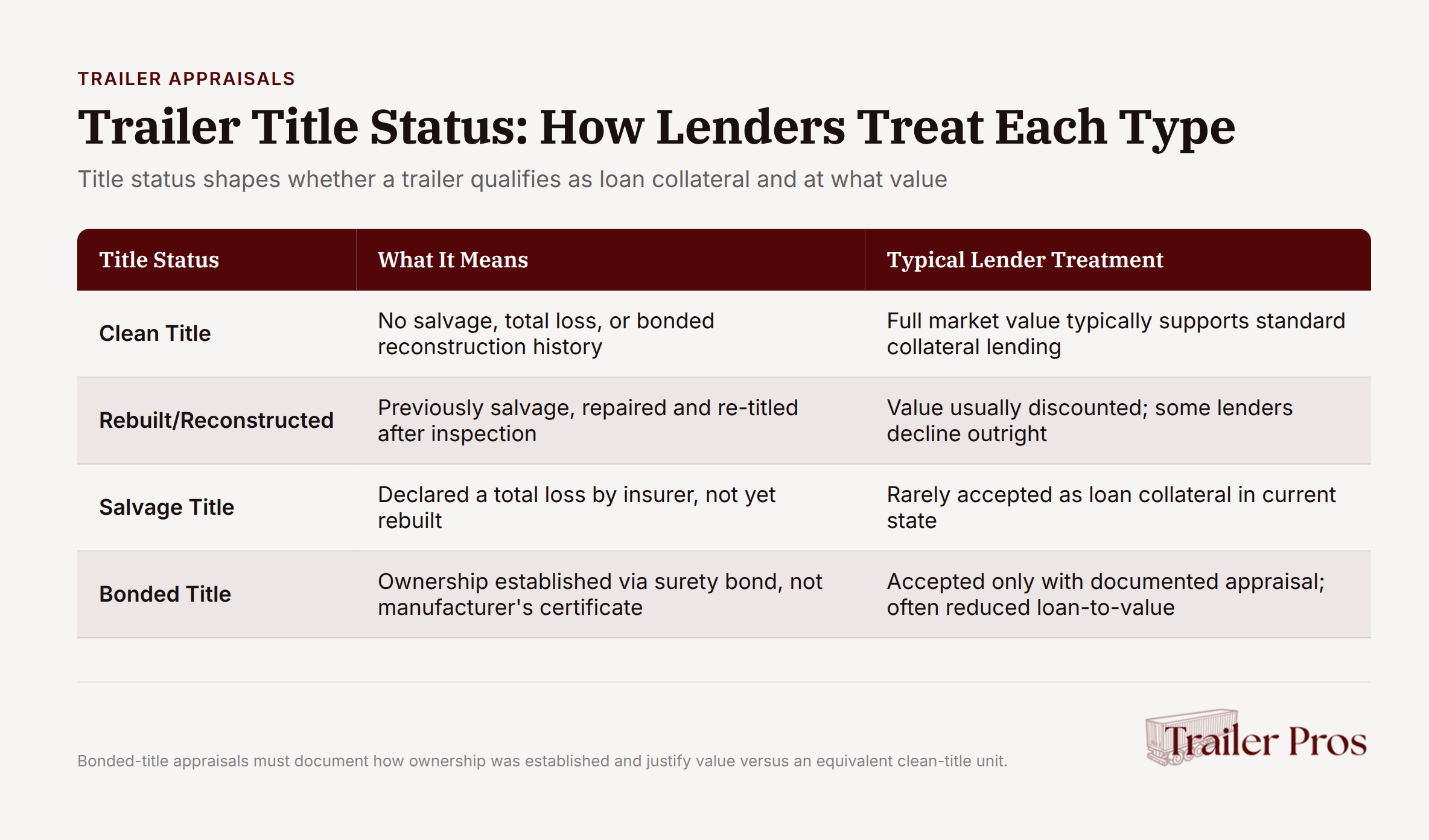
Title status is one of the biggest single factors in whether a lender will accept a trailer as collateral at all, separate from condition. A clean title supports full market-based lending, while a salvage or bonded title typically caps the loanable value or removes the trailer from eligibility entirely.
| Title Status | What It Means | Typical Lender Treatment |
|---|---|---|
| Clean title | No history of salvage, total loss, or bonded reconstruction | Full market value typically supports standard collateral lending |
| Rebuilt/reconstructed | Previously salvage, repaired and re-titled after inspection | Value is usually discounted; some lenders decline outright |
| Salvage title | Declared a total loss by an insurer, not yet rebuilt | Rarely accepted as loan collateral in its current state |
| Bonded title | Ownership established through a surety bond rather than a manufacturer's certificate | Often accepted only with a documented appraisal supporting the bonded value, and frequently at a reduced loan-to-value |
This is exactly why a trailer appraisal for bonded title situation looks different from a routine clean-title appraisal. The appraiser has to document how ownership was established, verify the bond amount aligns with a defensible value opinion, and make clear in the report why the trailer's marketability differs from an equivalent clean-title unit. Lenders reviewing a bonded-title file will scrutinize that documentation closely before extending credit.
Documented Upgrades vs Undocumented Modifications
Professionally documented upgrades can support a higher appraised value, but undocumented structural modifications almost always work against it. The difference comes down to whether the appraiser can verify the work and whether it improves or complicates resale.
A new heavy-duty axle upgrade with an invoice from a certified shop, a documented brake system conversion, or receipts for a new roof or flooring installation all give the appraiser something concrete to credit toward value. These upgrades are treated as improvements because they are verifiable and because a future buyer (or the lender, in a resale scenario) can trust that the work meets a recognized standard.
Undocumented modifications are a different story. A trailer with a welded-in frame extension, a home-built axle swap, or structural changes that cannot be traced to a shop or engineering standard raises red flags rather than value. Appraisers have to note these as limiting conditions, and lenders generally treat unverifiable structural work as added risk rather than added value, sometimes reducing the loanable amount even if the modification looks well executed.
Pro tip: Keep every receipt, invoice, and before-and-after photo for any work done to a trailer being used as collateral. Undocumented work, even good work, is functionally invisible to an appraiser and a lender.
Guide Value vs a Signed USPAP-Compliant Appraisal Report
A guide value and a signed appraisal report are not interchangeable for lending purposes. A guide value is a general market reference; a signed appraisal is an individually researched opinion of value, prepared to a recognized standard, that a lender can rely on for underwriting a specific asset.
Reference guides that estimate values for trailers, similar in spirit to blue book tools used for cars, are useful for a rough sense of the market. But they average condition, region, and configuration across a broad population of similar units. They do not inspect the specific trailer in front of the lender, they do not verify title status or modifications, and they carry no professional accountability if the number turns out to be wrong.
A signed appraisal report prepared in accordance with USPAP (the Uniform Standards of Professional Appraisal Practice) is different. USPAP's development and reporting standards require the appraiser to identify the intended use, disclose the scope of work performed, support the value conclusion with verifiable data specific to that trailer, and sign the report under a certification of independence. That is the level of documentation a bank or credit union's underwriting file needs, and it is why lenders increasingly ask for a signed report rather than a printout from a valuation guide.
Watch out: A dealer quote or a marketplace listing price is not an appraisal and will not satisfy most institutional underwriting requirements. Lenders are looking for an independent opinion, not a sales figure from a party with an interest in the transaction.
How Loan-to-Value Fits Into the Underwriting Decision
Loan-to-value, commonly shortened to LTV, is the ratio a lender uses to decide how much it will lend against an asset's appraised value. It is a lender-side underwriting decision, not something an appraisal report dictates or an appraiser sets.
Most asset-based lenders extend credit at a percentage of appraised value rather than the full amount, reserving a cushion to cover the cost of repossession and resale if the loan defaults. That cushion exists because a lender rarely recovers the gross appraised value in a forced sale: auction fees, transport, storage, and time all eat into the net recovery. The riskier or more specialized the asset, the more conservative the ratio tends to be, and title issues, condition problems, or undocumented modifications typically push a lender toward a lower ratio rather than a higher one.
This is also why the appraisal's premise of value matters. A report written for lending purposes generally reflects what the trailer would realistically bring in an orderly sale within a defined marketing period, not an optimistic retail price. Borrowers who expect the loan amount to match a retail listing price are often surprised when the lender's approved amount comes in lower. That gap is not a flaw in the appraisal; it reflects how lenders manage risk on personal property collateral, which has historically been viewed as harder to recover value from than real estate.
How to Prepare for a Trailer Appraisal for Loan Collateral
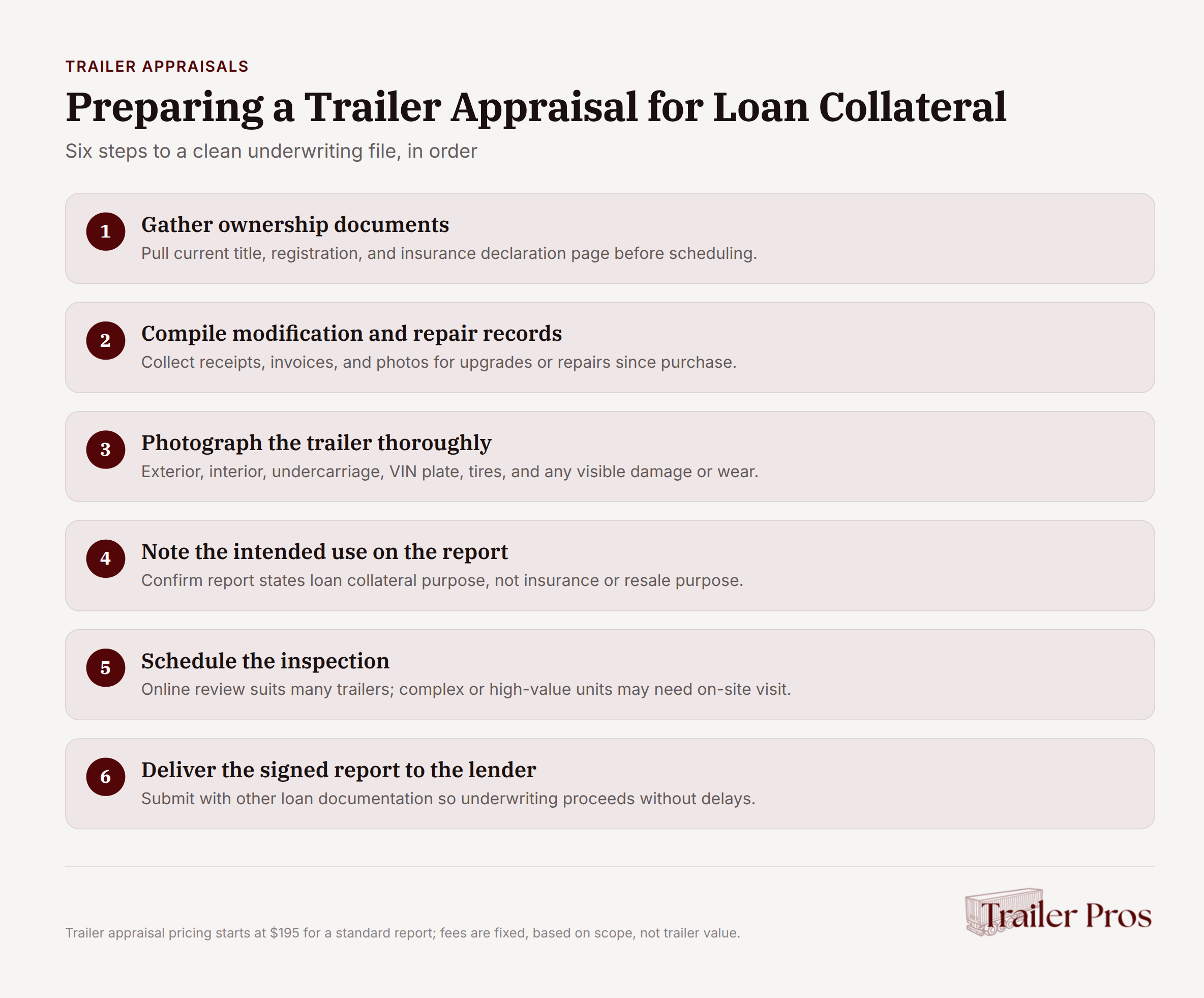
Borrowers who prepare their documentation in advance move through underwriting faster and get a cleaner report. The process generally follows the same order every time.
- Gather ownership documents: pull the current title, registration, and insurance declaration page before scheduling the appraisal.
- Compile modification and repair records: collect receipts, invoices, and photos for any upgrades or repairs performed since purchase.
- Photograph the trailer thoroughly: exterior, interior, undercarriage, VIN plate, tires, and any visible damage or wear.
- Note the intended use on the report: confirm with the appraiser that the report will state the loan collateral purpose, since a report written for insurance or resale purposes may not satisfy a lender's underwriting file.
- Schedule the inspection: online appraisal review works for many straightforward trailers, while more complex or high-value units may call for an on-site inspection.
- Deliver the signed report to the lender: submit the completed appraisal alongside the other loan documentation so underwriting can proceed without follow-up requests.
Engagements are quoted as a fixed fee before any work begins, never billed by the hour. For a trailer appraisal, that fee reflects the scope of the assignment (the complexity of the trailer, the completeness of the records provided, and whether the report needs to meet a formal, IRS-qualified level of documentation), not the value of the trailer itself. Current trailer appraisal pricing starts at $195 for a standard report, with more complex or higher-value fleet and specialty trailers running higher depending on scope.
Getting a Defensible Number Before You Apply
A trailer being pledged as loan collateral needs more than an owner's confidence in its value. It needs clean documentation, an honest condition assessment, clarity on title status, and a signed report built to a recognized standard that a lender's underwriting team can actually rely on. Skipping any of those steps tends to slow the loan down or shrink the amount a lender is willing to extend.
Our appraisers prepare trailer appraisal reports specifically scoped for lending and collateral use, built to hold up under a bank's or credit union's underwriting review. If a trailer is headed into a loan file, get the trailer appraisal for loan collateral process started early so the report is ready when the lender asks for it.
This article is provided for general informational purposes only and does not constitute legal, tax, or financial advice. Readers should consult a qualified attorney, CPA, or their lending institution regarding their specific circumstances.