
Blog
How Fair Market Value Is Calculated for a Donated Trailer, Step by Step
Fair market value for a donated trailer comes from comparable sales and condition adjustments, not a guess pulled from a pricing guide or your original purchase price. Here's the methodology appraisers use, and the penalty exposure the IRS imposes when a donor's valuation runs too high.
When you donate a trailer, whether it's a utility trailer, a cargo box, a horse trailer, or a flatbed, the IRS does not let you claim whatever number feels fair. The deduction rests on a specific, defensible figure: fair market value as of the date of the gift. This article walks through how appraisers actually build that number, the condition factors that move it up or down, and why a self-estimate can expose a donor to real tax penalties.
If you're preparing to donate a trailer and need the valuation itself, our trailer appraisal for charitable donation service produces the documentation this article describes. For a broader look at how trailer values are established outside the donation context, see our trailer value guide.
What Fair Market Value Means Under IRS Rules
Fair market value is the price a trailer would sell for on the open market between a willing buyer and a willing seller, with neither party under pressure to act and both having reasonable knowledge of the relevant facts. That definition comes directly from IRS Publication 561, and it governs every noncash charitable contribution, trailers included.
"Fair market value is the price at which the property would change hands between a willing buyer and a willing seller, neither being under any compulsion to buy or sell and both having reasonable knowledge of relevant facts." - IRS Publication 561
The key phrase is "on the valuation date." Fair market value is not what you paid for the trailer five years ago, and it is not what a dealer would charge to sell you a comparable new unit today. It's a snapshot of what an actual buyer would pay for this specific trailer, in this specific condition, on the day you handed over the title.
IRS Publication 561's Three Valuation Methods
Publication 561 recognizes three general approaches to establishing fair market value for donated property: comparable sales, replacement cost less depreciation, and the original cost or selling price of the item. For a trailer, these three methods do not carry equal weight.
- Comparable sales: looking at recent private-party sales of similar trailers, adjusted for differences in condition, equipment, and location.
- Replacement cost less depreciation: starting from what a new, equivalent trailer costs today and subtracting an estimate of accumulated wear and obsolescence.
- Cost or original selling price: using what the donor paid, weighted more heavily when the purchase happened close to the donation date in an arm's-length transaction.
Comparable sales is the primary and most defensible method for trailers, and it's the one appraisers lead with whenever usable market data exists. Replacement cost and original purchase price serve as cross-checks, not substitutes, because a trailer's resale value rarely tracks its replacement cost in a straight line once you factor in years of road use, rust, floor wear, and tire replacement cycles.
Why Comparable Sales Is the Defensible Approach for Trailers
The comparable-sales method works by finding actual transactions involving similar trailers and adjusting each one for the differences between that sale and the trailer being valued. This mirrors how the IRS evaluates donated vehicles and other tangible personal property generally, where a pricing guide can provide a starting clue but adjustments for condition, mileage or usage, and unusual equipment are expected before the figure holds up to scrutiny, as described in the IRS Form 8283 instructions.
For trailers specifically, generic vehicle pricing guides are a weak starting point because trailer values swing on factors a passenger-car guide was never built to capture: axle count, floor material, hitch configuration, and whether the title is clean or bonded. A defensible appraisal pulls comparables from trailer-specific listings and completed sales, not from a tool designed for cars and trucks.
Condition-Adjustment Factors Appraisers Weigh
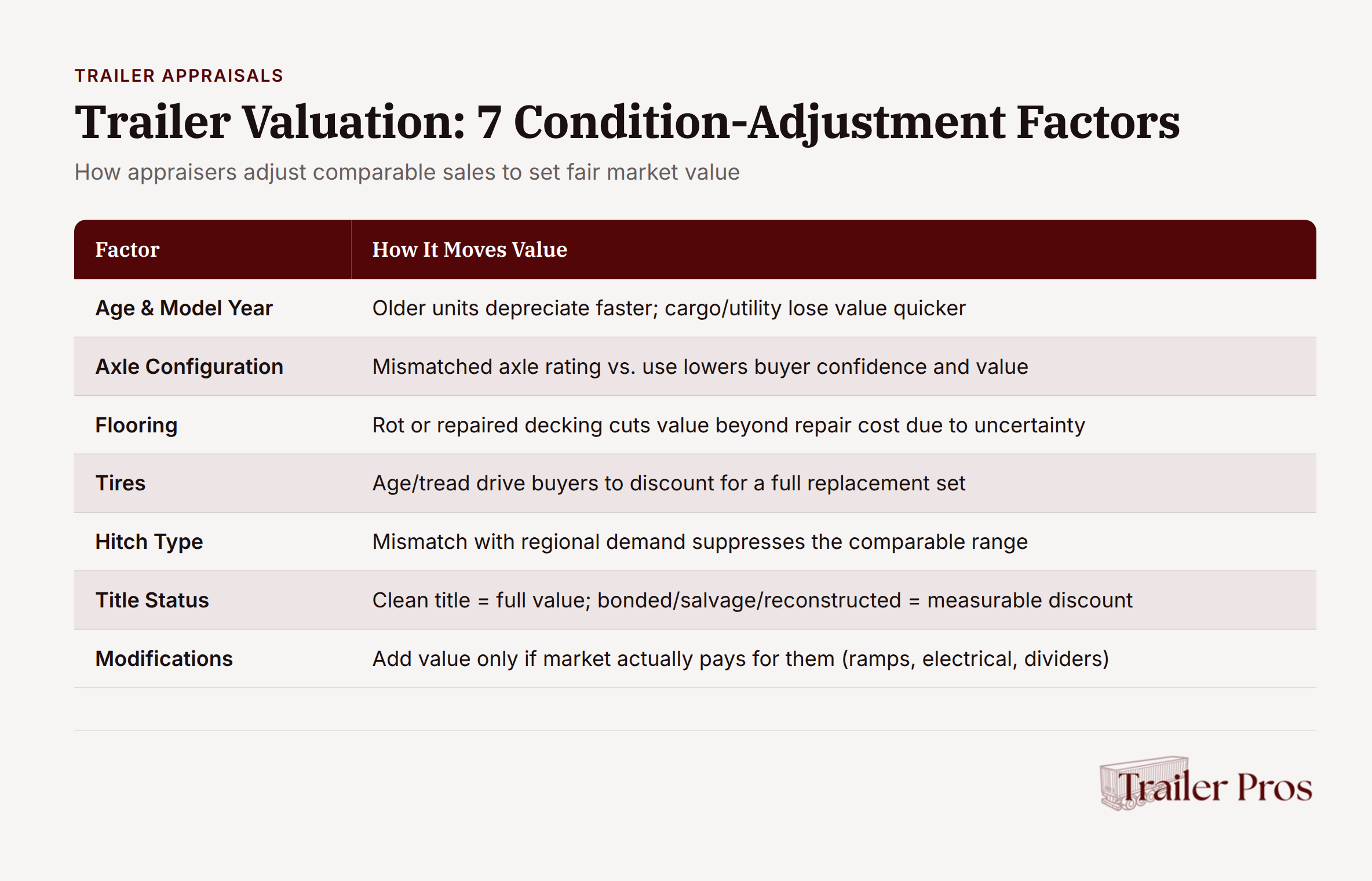
Once comparable sales are gathered, each one gets adjusted up or down to account for differences from the subject trailer. Appraisers routinely weigh the following factors when building that adjustment:
- Age and model year: older trailers depreciate on a curve that varies by type, with cargo and utility trailers often losing value faster in the first five years than well-built livestock or flatbed units.
- Axle configuration: single-axle versus tandem-axle or triple-axle changes both capacity and resale demand, and mismatched axle ratings relative to the trailer's advertised use lower buyer confidence.
- Flooring: wood decking that shows rot, delamination, or past repair work reduces value more than its repair cost alone would suggest, since buyers discount for uncertainty about what's underneath.
- Tires: tire age and tread condition matter more on trailers than on passenger vehicles, since trailer tires fail differently under load and buyers routinely budget for a full replacement set.
- Hitch type: bumper-pull, gooseneck, and fifth-wheel configurations serve different towing setups, and a mismatch with current market demand in a region can suppress the comparable range.
- Title status: a clean title supports full market value, while a bonded, salvage, or reconstructed title drives a measurable discount that must be reflected in the adjustment grid.
- Modifications: aftermarket additions like custom ramps, added electrical systems, or livestock dividers can add value, but only when they match what buyers in that trailer's specific market actually pay for.
A Worked Example: Comparable-Sales Adjustment Grid for a Flatbed Trailer
Here's how the adjustment process looks in practice for a 2017 20-foot flatbed trailer with tandem axles, a clean title, and moderate deck wear, donated in the current tax year.
| Comparable | Sale Price | Age Adjustment | Deck Condition Adjustment | Tire Adjustment | Adjusted Value |
|---|---|---|---|---|---|
| Comp A (2016, worn deck, new tires) | $6,200 | -$100 | +$400 | -$300 | $6,200 |
| Comp B (2018, good deck, half-worn tires) | $7,000 | +$150 | -$200 | $0 | $6,950 |
| Comp C (2017, rotted deck sections, old tires) | $5,400 | $0 | +$600 | +$400 | $6,400 |
Averaging the three adjusted figures puts the subject trailer's fair market value at roughly $6,500. Notice that no single comparable's raw sale price was used directly. Each one was corrected for its differences from the subject trailer before being weighted into the conclusion. That adjustment trail, not just the final number, is what makes an appraisal defensible if the IRS ever asks for support.
Why Self-Estimates Create Audit Risk
Donors commonly reach for a Kelley-style pricing guide, plug in a make and model, and subtract a rough guess for wear. That approach fails for trailers on two fronts. First, most general vehicle guides don't carry reliable trailer data at all, particularly for cargo, livestock, and custom flatbed units. Second, even when a guide lists a figure, it typically reflects a dealer retail price rather than the private-party sale price that governs fair market value for donation purposes, a distinction the IRS draws explicitly for other donated vehicles under the same Publication 561 framework.
Watch out: Starting from what you originally paid and subtracting a flat percentage for "depreciation" is not a valuation method the IRS recognizes on its own. It can support a comparable-sales conclusion as a cross-check, but it cannot replace one.
The IRC 6662 Accuracy-Related Penalty Exposure
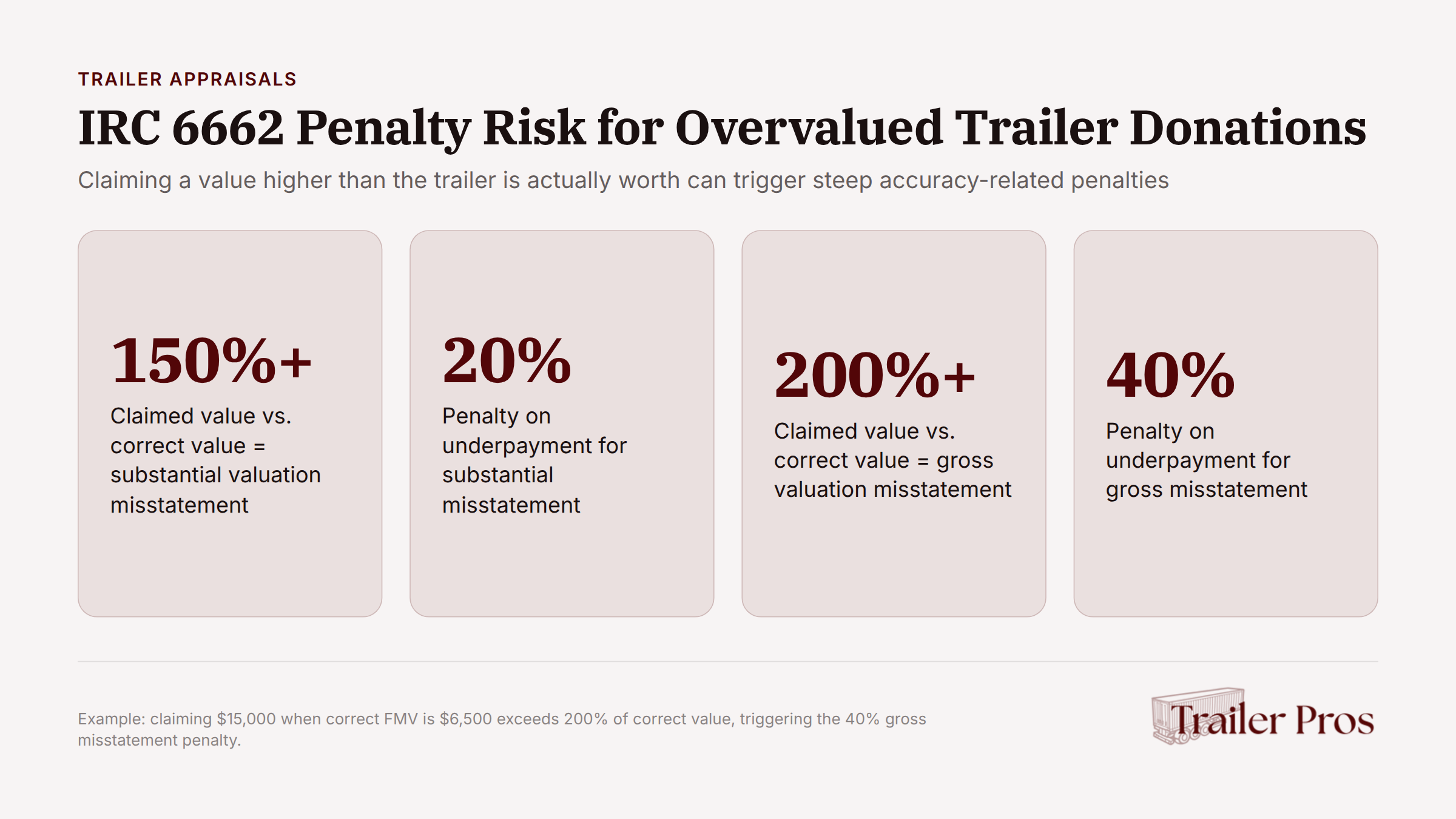
Overstating a donated trailer's value doesn't just risk a reduced deduction. It can trigger an accuracy-related penalty under the tax code's substantial and gross valuation misstatement provisions. A substantial valuation misstatement applies when the claimed value is 150% or more of the correct value, carrying a 20% penalty on the resulting underpayment. A gross valuation misstatement, where the claimed value reaches 200% or more of the correct value, carries a 40% penalty.
Example: If an appraiser later determines the trailer's correct fair market value was $6,500 but the donor claimed $15,000 on the return, that claimed figure sits well above 200% of the correct value. The resulting underpayment would be subject to the 40% gross misstatement penalty rather than the standard 20% rate.
Key takeaway: The gap between a defensible comparable-sales conclusion and an inflated self-estimate isn't just a matter of a smaller deduction if challenged. It's the difference between no penalty and a 20% or 40% penalty layered on top of the tax owed.
When a Qualified Appraisal Is Required
For any noncash contribution exceeding $500, a donor generally must file Form 8283 with the return, as outlined in the IRS Form 8283 instructions. Once the claimed deduction for the trailer exceeds $5,000, the rules tighten further: the donor must obtain a qualified appraisal from a qualified appraiser, complete Section B of Form 8283, and attach it to the return. These requirements come from 26 C.F.R. § 1.170A-13 and 26 C.F.R. § 1.170A-16, and the appraisal itself must be dated no earlier than 60 days before the contribution and no later than the return's filing deadline, including extensions.
It's worth being clear about one point that trips donors up: towable trailers are not motor vehicles under the IRS's qualified-vehicle rules, so the Form 1098-C regime that governs donated cars, boats, and planes does not apply here. A trailer donation follows the general noncash-contribution and qualified-appraisal rules described above, not the vehicle-specific gross-proceeds limitation. Treating a trailer like a car for tax purposes is a common and avoidable mistake.
Our appraisers hold credentials with organizations such as the ASA and ISA and prepare every trailer valuation to the standard required for Section B of Form 8283, whether the subject is a horse trailer, a flatbed, a cargo box, or a travel trailer.
Getting the Valuation Right the First Time
A fair market value conclusion for a donated trailer holds up when it's built the way the IRS expects: from real comparable sales, adjusted line by line for the specific trailer's age, axle setup, flooring, tires, hitch, title status, and modifications. Skipping that process in favor of a guess or a mismatched pricing guide doesn't just risk a smaller deduction. It risks a penalty on top of it.
If you're planning a trailer donation and want a valuation built on a documented comparable-sales grid rather than a rough estimate, our team can scope and deliver a qualified appraisal before your filing deadline.
This article is provided for general informational purposes only and does not constitute legal, tax, or financial advice. Readers should consult a qualified attorney or CPA regarding their specific circumstances.