
Blog
How a Diminished Value Trailer Appraisal Helps You Recover What an Accident Cost You
A diminished value trailer appraisal documents the resale value your trailer lost after collision repairs, even when the repair itself was done correctly. This guide covers when to file, how the appraisal is performed, and how state law shapes what an insurer actually owes you.
When a trailer gets hit and repaired, most owners assume the story ends once the frame is straightened and the invoice is paid. It doesn't. A trailer with a collision and repair history is worth less to a buyer than an identical trailer with a clean record, even when the repair work is flawless. That gap between what the trailer would have sold for and what it sells for now is called diminished value, and in most states it is a recoverable loss separate from the repair bill itself.
This guide covers what diminished value means for a trailer, when it applies, how a trailer appraisal for an insurance claim actually calculates the number, and what happens when an insurer pushes back on your figure.
What Diminished Value Means for a Trailer
Diminished value is the reduction in a trailer's fair market value that results from a collision and its repair history, measured as the difference between pre-loss value and post-repair value. Courts have long treated this gap as a form of property damage in its own right, not just a byproduct of the repair estimate.
An Indiana appellate decision involving a damaged truck confirmed this directly: the court approved recovery of diminished value even where the vehicle had been fully and properly repaired, because the fair market value still came in lower than before the accident, according to a summary of the ruling from a personal injury law firm covering the case. A West Virginia decision reached a similar conclusion, holding that an owner can recover diminution in value after repair provided they show the damage was structural and that total recovery does not exceed the trailer's pre-accident market value, as summarized in case-brief coverage of Ellis v. King.
Inherent vs. Repair-Related Diminished Value
There are two distinct flavors of diminished value, and a trailer appraisal needs to identify which one applies:
- Inherent diminished value: the trailer was repaired correctly, to proper specification, with no shortcuts, and it still lost resale value simply because buyers and dealers discount any unit with a documented accident history.
- Repair-related diminished value: the repair itself was incomplete, used non-OEM parts, or left the trailer in a condition below its pre-loss standard, so the loss in value is tied to the quality of the work, not just the fact that damage occurred.
The distinction matters because inherent diminished value claims rest on market perception and comparable sales data, while repair-related claims also require documenting exactly what the repair failed to restore.
When Should You File a Diminished Value Claim on a Trailer?
File a diminished value claim after collision damage to a trailer's frame, axles, structural walls, or suspension, not after routine cosmetic wear or minor road damage that a buyer would never ask about. The claim only makes sense when the damage was significant enough, and the repair extensive enough, that a knowledgeable buyer would discount the price if they knew the history.
Hail dents, faded paint, or worn flooring don't typically create a diminished value claim because they don't carry a stigma tied to structural integrity. A bent frame rail, a repaired axle mount, or a patched sidewall on a cargo or semi trailer, on the other hand, is exactly the kind of damage that shows up on a vehicle history report or gets disclosed during a pre-purchase inspection, and that disclosure is what drives the price down.
How a Trailer Diminished Value Appraisal Is Performed
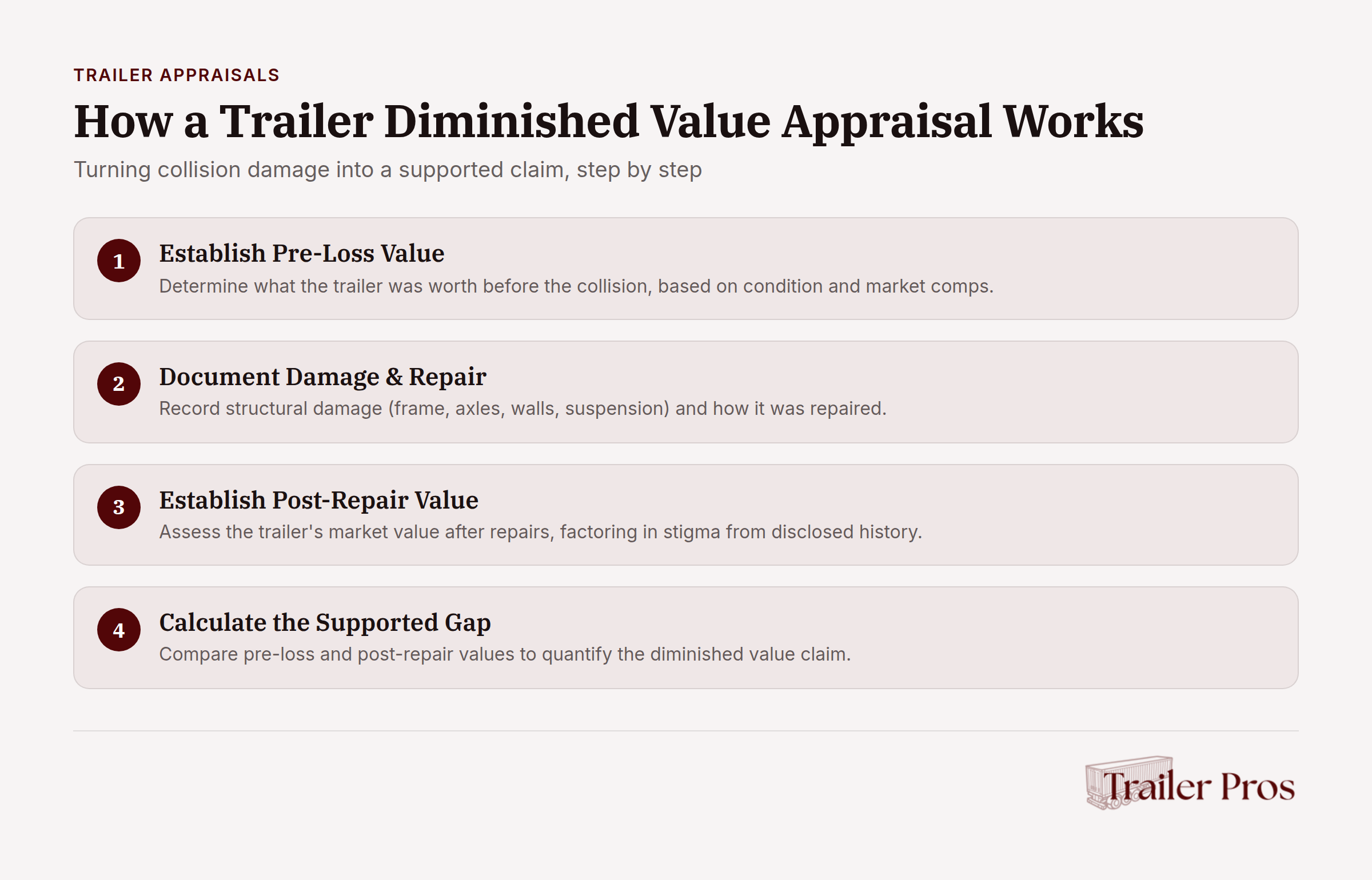
A trailer diminished value appraisal compares the trailer's fair market value immediately before the accident against its fair market value after repairs are complete, using comparable sales to support both figures. The difference between those two numbers, adjusted for the severity of the damage and the trailer's age and usage, is the diminished value.
The process generally follows these steps:
- Establish pre-loss value. The appraiser researches comparable sales, auction results, and equipment valuation guides for the same make, model, configuration, and age, arriving at a defensible pre-accident fair market value.
- Document the damage and repair. The appraiser reviews the repair invoice, shop records, and photographs to understand exactly what was damaged (frame, axles, structural panels) and how it was fixed (OEM parts, aftermarket parts, factory-spec welds).
- Establish post-repair value. The appraiser researches how buyers and dealers in that trailer's market actually price units with a disclosed accident and repair history, using comparable listings and sales where that history is known.
- Calculate and support the gap. The difference between pre-loss and post-repair value becomes the diminished value figure, backed by the comparable sales data rather than a flat percentage.
Some insurers still lean on simplified formulas rather than market data. The National Association of Insurance Commissioners has documented Georgia's so-called "17(c)" formula, which multiplies 10% of a vehicle's pre-loss retail value by a damage severity modifier and a mileage or usage modifier, as a common industry starting point, per the NAIC's 2023 report on automobile diminished value. That same report notes the formula has drawn criticism for under-compensating owners because it doesn't reflect how a specific trailer actually trades in the market, which is exactly why an independent, comparable-sales-based appraisal tends to hold up better than a generic insurer worksheet.
Courts have also recognized that repair cost and diminished value aren't always separate categories. Where a repair doesn't fully restore market value, a claimant may be entitled to both the cost of repair and the remaining diminished value, capped at the trailer's total pre-loss worth, a principle discussed in academic analysis of inherent diminished value in vehicle damage claims.
Key takeaway: an appraisal built on real comparable sales for your specific trailer type will generally carry more weight in a dispute than an insurer's generic percentage-based formula.
First-Party vs. Third-Party Claims: Why State Law Controls the Outcome
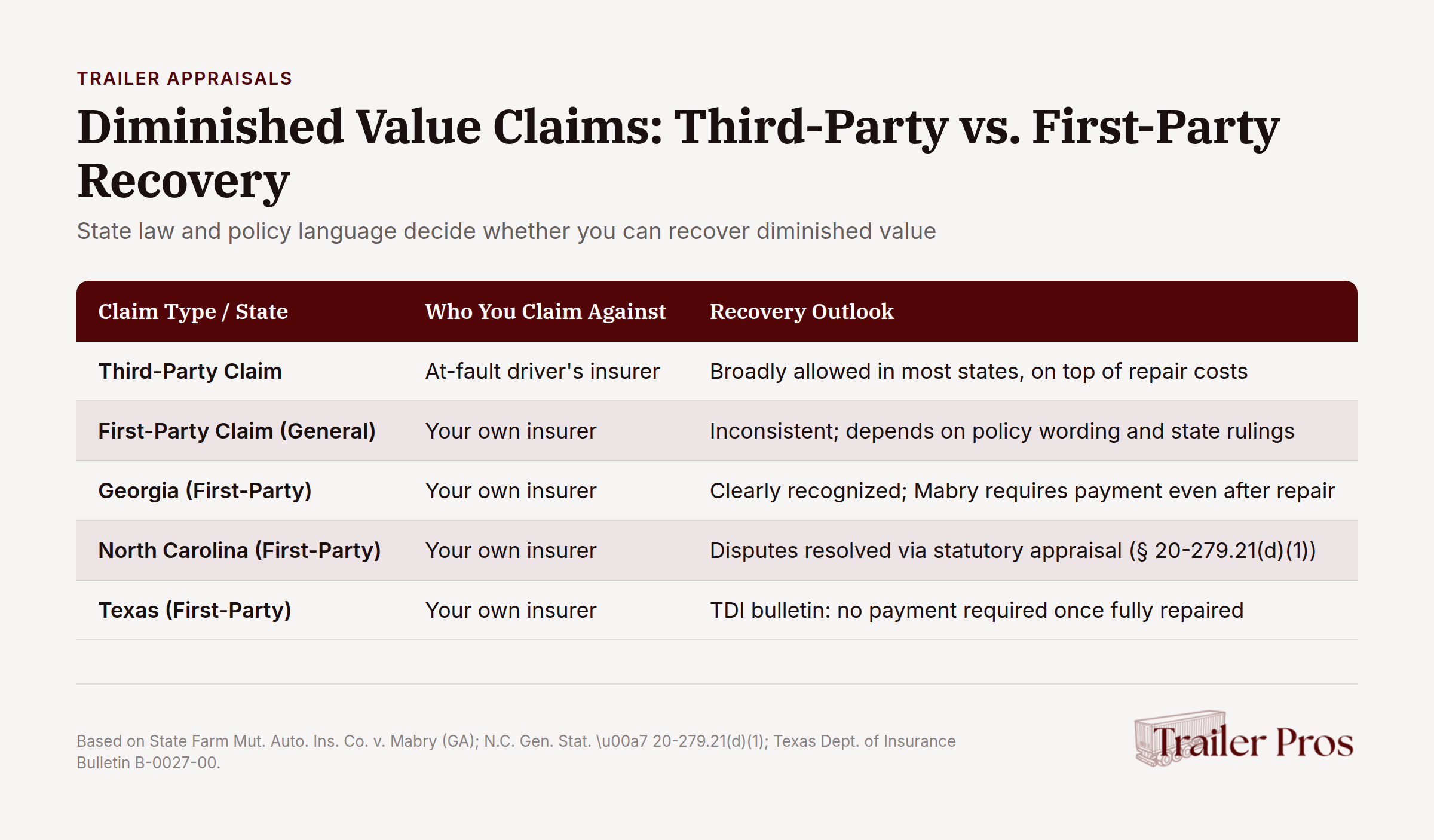
Whether you can recover diminished value on a trailer depends heavily on whether you're filing against the at-fault party's insurer (third-party) or your own insurer (first-party), and on what your state's law says about each. Third-party diminished value claims are broadly recognized: if another driver damaged your trailer, most states allow you to pursue the reduction in market value from their insurer in addition to the repair cost.
First-party claims, where you're asking your own insurer to pay diminished value under your own policy, are far less consistent from state to state. Two examples illustrate how differently this plays out:
- Georgia recognizes first-party diminished value recovery directly. The Georgia Supreme Court held in State Farm Mut. Auto. Ins. Co. v. Mabry that an insurer's obligation to pay for a loss includes the diminished value of a vehicle even after it has been fully repaired, establishing Georgia as one of the clearest states for first-party recovery.
- North Carolina addresses diminished value appraisal disputes through its own statutory appraisal process under N.C. Gen. Stat. Section 20-279.21(d)(1), which sets out how a disagreement over the amount of loss, including diminished value, gets resolved between the owner and the insurer.
Most other states fall somewhere in between, and the outcome typically comes down to two things: what the policy language actually says about diminished value, and how that state's courts or insurance regulator have interpreted it. A Texas Department of Insurance bulletin, for example, states plainly that a standard auto policy does not obligate an insurer to pay first-party diminished value once a vehicle is fully repaired to its pre-damage condition, according to Texas Department of Insurance Bulletin B-0027-00. That position is common among insurers nationwide unless a specific state statute or court ruling says otherwise.
When the Insurer Disputes Your Number: the Appraisal Clause and Umpire Process
Most trailer and commercial auto policies include an appraisal clause specifically for this scenario: you and the insurer disagree on the amount of loss, and neither side wants to go to court over it. Either party can invoke the clause, at which point each side selects its own appraiser, and those two appraisers select a neutral umpire.
The process generally works like this: your appraiser and the insurer's appraiser each submit an independent valuation of the diminished value. If they agree, that number becomes binding. If they don't, the dispute goes to the umpire, and any two of the three parties (your appraiser, the insurer's appraiser, or the umpire) reaching agreement sets the final figure. This is precisely the mechanism referenced in North Carolina's statutory appraisal provision, and similar clauses appear in policies across most states regardless of whether the state has separate diminished value statutes.
A well-documented, market-based appraisal carries more weight in this process than a rough estimate, because the umpire is weighing two competing valuations and will lean toward whichever one is better supported by actual comparable sales data.
Documentation to Gather Before You File
A diminished value claim lives or dies on documentation. Before filing, gather:
- The repair invoice and shop records, showing exactly what was damaged, what parts were used, and whether the repair met OEM specifications.
- Photographs from before and after the accident, including any photos that show the trailer's pre-loss condition (age, wear, prior modifications) so the appraiser has a true baseline.
- Registration, title, and maintenance records, which help establish the trailer's age, usage, and configuration for comparable sales research.
- The accident report and any correspondence with the at-fault party's insurer, since this establishes causation and which claim (first-party or third-party) applies.
- A copy of your own policy's appraisal clause language, so you know the process and deadlines if the insurer disputes your number.
Watch out: Don't wait until the repair shop returns the trailer to start gathering pre-loss documentation. Photos and records taken before repairs begin are far more persuasive than anything reconstructed afterward.
What a Trailer Diminished Value Appraisal Costs
A standard trailer appraisal for a diminished value claim starts at $195, with typical engagements running $195 to $495 depending on the trailer's complexity and the depth of comparable sales research required. Larger commercial units, fleet trailers, or claims that require litigation support and appraisal-clause testimony run higher, generally $1,800 to $4,500 or more, since those engagements involve more extensive documentation and often direct communication with the umpire or opposing appraiser.
Every engagement is quoted as a fixed fee after we understand the scope of the assignment: the trailer type, the extent of the damage, and whether the report needs to support an appraisal-clause dispute or potential litigation. Fees are never billed hourly, and they are never based on how much the diminished value claim is worth: the appraisal fee reflects the work required to build a defensible report, not the size of your eventual recovery.
Protecting the Value an Accident Already Cost You
A collision doesn't just cost you a repair bill. It can quietly cost you a slice of your trailer's resale value for as long as you own it, and that loss doesn't show up anywhere unless someone documents it. Whether you're dealing with your own insurer or the at-fault party's carrier, the strength of your claim comes down to one thing: a market-based appraisal that shows exactly what your trailer was worth before, what it's worth now, and why.
If you're facing a diminished value dispute on a trailer, our team can prepare a USPAP-compliant appraisal built on real comparable sales, ready to support your claim through negotiation, the appraisal clause process, or litigation if it comes to that. Request a trailer appraisal to get started.
This article is provided for general informational purposes only and does not constitute legal, tax, or financial advice. Readers should consult a qualified attorney regarding their specific circumstances and state law.