
Blog
How to Get a Commercial Trailer Appraisal for Insurance and Loan Financing
A commercial trailer appraisal for insurance loan financing establishes a documented, USPAP-compliant value that lenders and insurers can rely on for collateral, coverage, and claims decisions. Here's what the process covers, what a report must include, and how to request one.
A commercial trailer (a dry van, reefer, flatbed, or specialized unit) is a significant asset whether it's sitting on a balance sheet as loan collateral or scheduled on an insurance policy. When that trailer changes hands financially, whether through a new loan, a refinance, or a coverage renewal, the lender or insurer usually wants more than a guess at what it's worth. That's where a formal trailer appraisal comes in.
What Is a Commercial Trailer Appraisal?
A commercial trailer appraisal is a formal valuation of a trailer, prepared by a qualified appraiser and developed in accordance with the Uniform Standards of Professional Appraisal Practice (USPAP), to support a specific financial or legal decision. Trailers are treated as personal property (equipment) for appraisal purposes, distinct from real estate, which means the assignment follows the personal property valuation standards rather than a real estate framework, a distinction the Counselors of Real Estate explain in detail.
Unlike a quick online estimate or a dealer's trade-in quote, a USPAP-compliant appraisal documents the trailer's identification, condition, the market data used, and the reasoning behind the final number. That documentation is exactly what lenders and insurers need when a trailer's value is going to support a loan balance or a policy limit.
Our team prepares these reports for owners moving through a trailer appraisal for loan collateral, and the same underlying methodology applies whether the trailer in question is a single flatbed or part of a larger fleet, including semi trailer appraisal assignments for over-the-road equipment.
Why Lenders Require a Trailer Appraisal for Loan Collateral
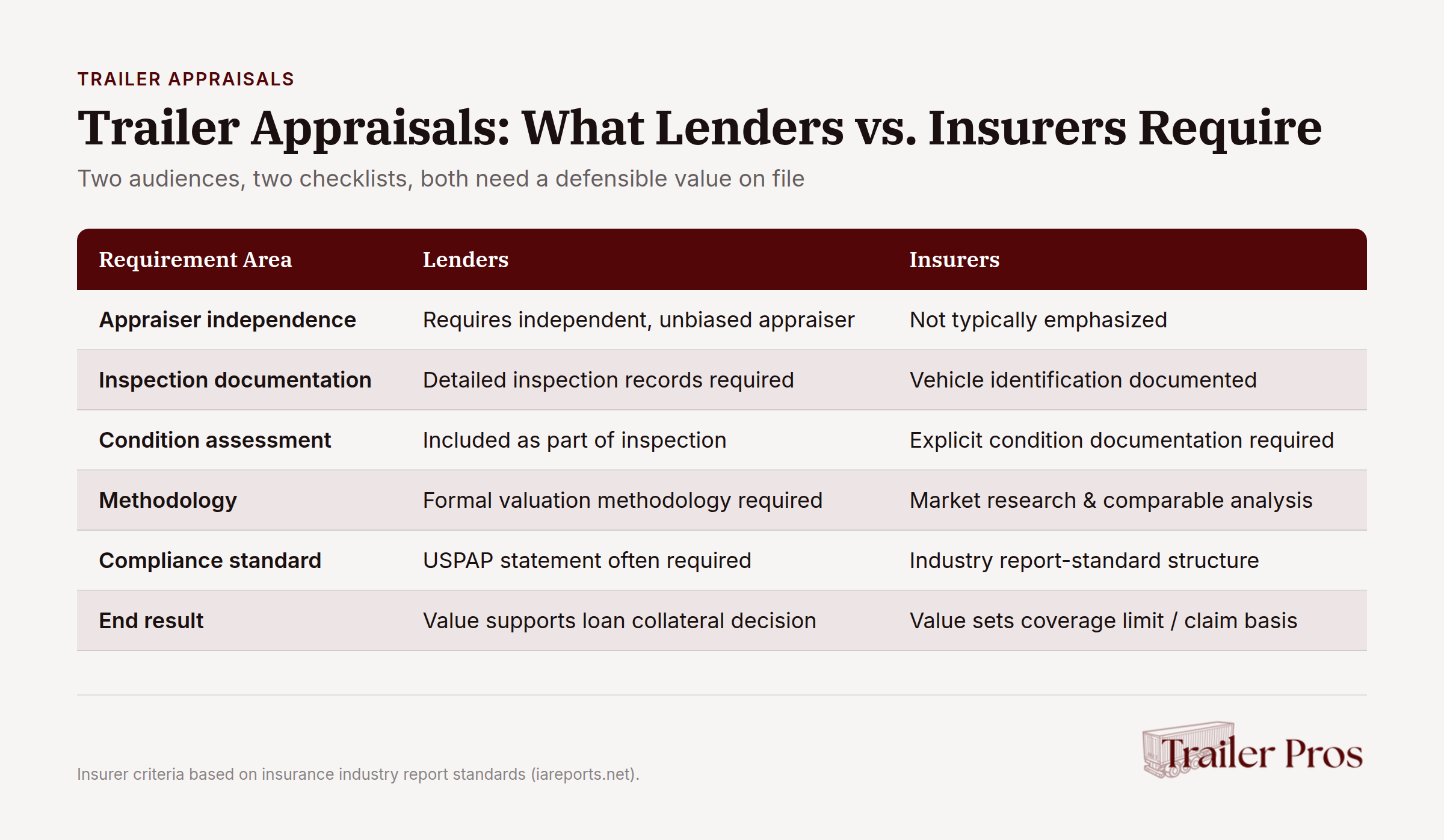
Lenders require a trailer appraisal because they need an independent, defensible value to set the loan-to-value ratio and confirm the collateral actually supports the amount being borrowed. This isn't a formality; it's baked into how regulated lending works.
Following the savings-and-loan crisis, federal banking regulators adopted USPAP as the baseline standard for appraisals used in federally related lending transactions, a requirement that has carried forward into how banks and credit unions evaluate equipment collateral today. For SBA-backed loans specifically, current guidance calls for personal property appraisals used as collateral to comply with USPAP and to be prepared by a qualified, independent appraiser, with the appraisal typically needing to be completed within about 12 months of loan approval and finished before closing, according to published SBA 504 appraisal guidelines.
Underwriters reviewing a trailer appraisal are generally looking for a few consistent things:
- Independence: the appraiser has no financial stake in the loan outcome or the trailer's sale.
- On-site inspection or documented photo review: confirming the trailer physically exists and matches its description.
- A stated methodology: how the appraiser reached the number, not just the number itself.
- A USPAP compliance statement: the report explicitly says it was developed and reported under USPAP.
We prepare our trailer appraisals to meet these documentation expectations, but acceptance of any appraisal report always rests with the reviewing lender, not with us.
Why Insurers Require a Trailer Appraisal
Insurers request a trailer appraisal to set an accurate coverage limit and to have a defensible value on file before a claim ever happens. Without that documentation, a total-loss or major-damage claim can turn into a drawn-out dispute over what the trailer was actually worth.
Vehicle appraisal report standards used across the insurance industry call for consistent documentation of the vehicle's identification, condition, market research, comparable analysis, and final value conclusion, according to insurance industry report standards. That structure lets an underwriter set an agreed-value or scheduled policy limit with confidence, and it gives an adjuster a clear basis for settlement if the trailer is ever damaged or stolen.
For owners weighing whether they need this kind of report before a claim happens, our trailer value guide walks through the difference between an informal estimate and a documented appraisal.
How Fair Market Value Is Determined Under USPAP
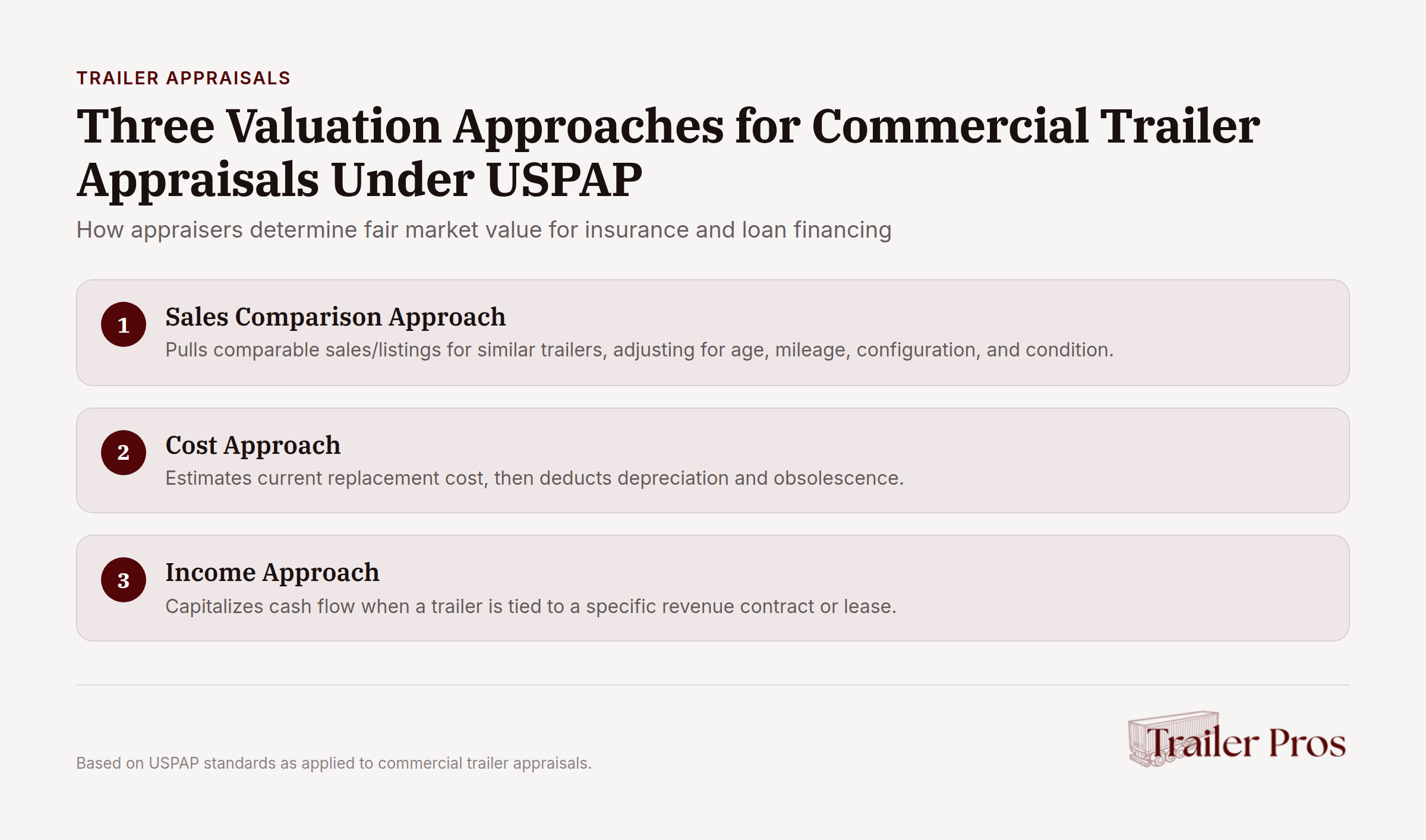
Under USPAP, fair market value for a trailer is the price at which it would change hands between a willing buyer and a willing seller, with neither under compulsion to act and both reasonably informed about the trailer's condition and the market. USPAP itself doesn't dictate a single formula for reaching that number; it requires the appraiser to consider recognized valuation approaches and document which ones were used.
For a commercial trailer, that generally means working through some combination of the following:
- Sales Comparison Approach. The appraiser identifies the relevant market for that trailer type (dry van, reefer, flatbed, tank) and pulls comparable sales or current listings for similar units, then adjusts for differences in age, mileage or usage, configuration, options, and condition.
- Cost Approach. The appraiser estimates the current replacement cost of a similar trailer and deducts physical depreciation and any functional or economic obsolescence to arrive at an indicated value.
- Income Approach. Less common for a standard trailer, but relevant when the unit is tied to a specific revenue-producing contract or lease, in which case the appraiser may capitalize the associated cash flow.
Most residential-scale trailer appraisals lean heavily on the sales comparison approach, since active markets for used trailers make comparable data reasonably available. For larger fleets, appraisers sometimes apply mass appraisal techniques, which allow a documented sampling methodology across many similar units rather than a fully independent analysis of every trailer, a practice detailed by Clean Fleet Report's guide for fleet operators.
Fair market value isn't the only premise a lender might need. Asset-based lenders sometimes request orderly liquidation value, which reflects expected proceeds under a reasonable marketing period rather than a typical retail sale, or forced liquidation value for distressed-collateral scenarios. Which premise applies is part of the assignment's scope of work and should be settled before the appraisal starts.
What a USPAP-Compliant Trailer Appraisal Report Includes
A complete trailer appraisal report contains enough detail that a lender, insurer, or court could follow the appraiser's reasoning from identification through final value, without needing to ask follow-up questions. At minimum, that means:
- Assignment details: the client, the intended use (loan collateral, insurance, litigation), and who is entitled to rely on the report.
- Trailer identification: year, make, model, body type, VIN, axle configuration, and any specialized equipment (refrigeration units, lift gates, tarping systems).
- Condition and usage notes: mileage or hours where tracked, observed wear, damage, modifications, and maintenance history reviewed.
- Market definition and effective date: the relevant market researched and the specific date the value applies to.
- Comparable data and adjustments: the comparable trailers considered and how they were adjusted to the subject.
- Valuation approach and reconciliation: which approaches were used, why others were set aside, and how the final number was reached.
- Value conclusion: the stated value type (fair market value, orderly liquidation value, or another premise) and the dollar figure.
- Assumptions and limiting conditions: anything the appraiser assumed, such as clear title or completed repairs.
- USPAP compliance certification: a signed statement confirming the appraisal was developed and reported in accordance with USPAP, a framework maintained by The Appraisal Foundation.
Our appraisers hold credentials with organizations such as the American Society of Appraisers and the Certified Appraisers Guild of America, and every report is built to carry the documentation a lender's credit file or an insurer's underwriting file expects to see.
What Information You'll Need to Provide
A faster, more accurate appraisal starts with good information from the owner. Before we can scope and complete a trailer appraisal, we typically need:
- Basic identification: year, make, model, VIN, and trailer type (dry van, reefer, flatbed, tank, curtain-side, or specialized).
- Ownership documentation: a copy of the title or registration, and lease agreements if the trailer is part of a fleet.
- Usage and condition history: current mileage or usage estimates, maintenance and inspection records, and disclosure of any known frame damage, prior accidents, or structural repairs.
- Photographs: clear images of all sides, the undercarriage where accessible, the interior, and any specialty equipment.
- Intended use and required value premise: whether the appraisal is for a loan, an insurance policy, or another purpose, and whether the lender or insurer has specified fair market value, orderly liquidation value, or another standard.
Having this ready before the assignment starts keeps the process moving and reduces the number of follow-up questions our appraisers need to ask.
How to Request a Commercial Trailer Appraisal
Start by confirming exactly what your lender or insurer needs: the required value premise, whether an on-site inspection is mandatory, and the effective date the value should reflect. From there, the process generally follows these steps:
- Confirm the requirement. Ask the underwriter or loan officer whether a USPAP-compliant personal property appraisal is required and what format they expect.
- Submit your trailer details. Provide the identification, ownership documentation, condition history, and photographs described above.
- Define the assignment in writing. The engagement should state the client, intended use, required value premise, and effective date before work begins.
- Receive the completed report. Our appraisers prepare the report to include the identification, methodology, comparable analysis, valuation conclusion, and USPAP compliance certification your lender or insurer will review.
- Deliver the report to your underwriter. The lender or insurance carrier makes the final call on how the appraisal factors into their decision.
Our trailer appraisal fees are quoted as a fixed fee after we scope the assignment, never billed hourly. For standard trailer appraisals, fees typically start at $195, with a typical range of $195 to $495 depending on the complexity of the assignment and the depth of analysis required; highly complex fleet or specialized-configuration assignments can run $1,800 to $4,500 or more. If your lender or insurer requires a heavier level of documentation, we'll scope that into the quote before work begins.
Whether you're financing new equipment, refinancing an existing fleet, or renewing coverage on a trailer that's appreciated or depreciated since the last policy period, a documented appraisal gives everyone involved, you, your lender, and your insurer, the same defensible starting point.
This article is provided for general informational purposes only and does not constitute legal, tax, or financial advice. Readers should consult their lender, insurer, or a qualified professional regarding their specific circumstances.